


Virus-induced transgene- and tissue culture-free heritable genome editing in tomato
Ye Liu, Trevor Weiss, Jinhee Lee, Jessica Powell, Shi Ying Charlize Choo, Elnaz Roshannai, Maris Kamalu, Jasmine Amerasekera, Suhua Feng, and Steven E. Jacobsen
PNAS; June 4, 2026; 123 (23) e2530029123;
https://doi.org/10.1073/pnas.2530029123
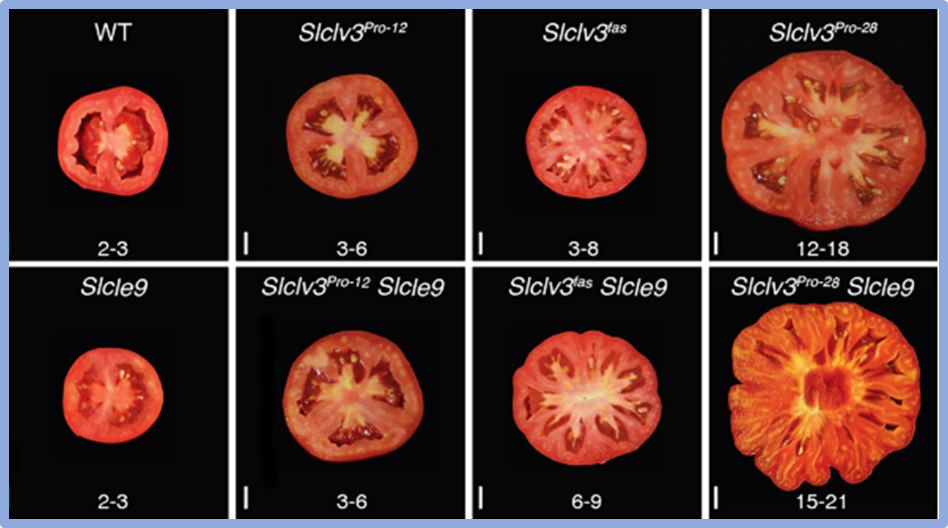
Significance
Efficient genome editing without the need for transgenesis or tissue culture remains a major challenge in crop breeding. Here, we establish a simple single-step system for transgene- and tissue culture-free genome editing in tomato based on Tobacco rattle virus-mediated delivery of the compact RNA-guided TnpB enzyme ISYmu1 and its guide RNA. This strategy enabled somatic editing of de novo shoots and heritable transmission of targeted mutations to the next generation. Notably, editing an agronomically relevant gene produced tomato plants with larger fruits, highlighting the potential of this system for crop improvement.
Abstract
Genome editing has emerged as a powerful tool for genome manipulation and trait improvement in crops. However, most commonly used approaches rely on tissue culture and transgenic materials, which are time-consuming, labor-intensive, and often strongly genotype-dependent. Here, we developed a Tobacco rattle virus (TRV)-based system to deliver the compact ISYmu1 TnpB endonuclease, coupled with in planta shoot regeneration, to achieve somatic and heritable genome editing across different tomato cultivars without tissue culture. By targeting SlPDS, we successfully generated virus-free homozygous mutant progeny in a single generation. Furthermore, we extended this system to the functional analysis of the previously uncharacterized SlDA1 locus, revealing its involvement in organ size regulation, and recovered transgene-free SlDA1 mutants displaying enlarged fruits. Given the wide host range of TRV, our system should be broadly applicable for rapid, nontransgenic and less genotype-dependent heritable genome editing, thereby advancing both functional genomics and crop improvement.
See https://www.pnas.org/doi/10.1073/pnas.2530029123
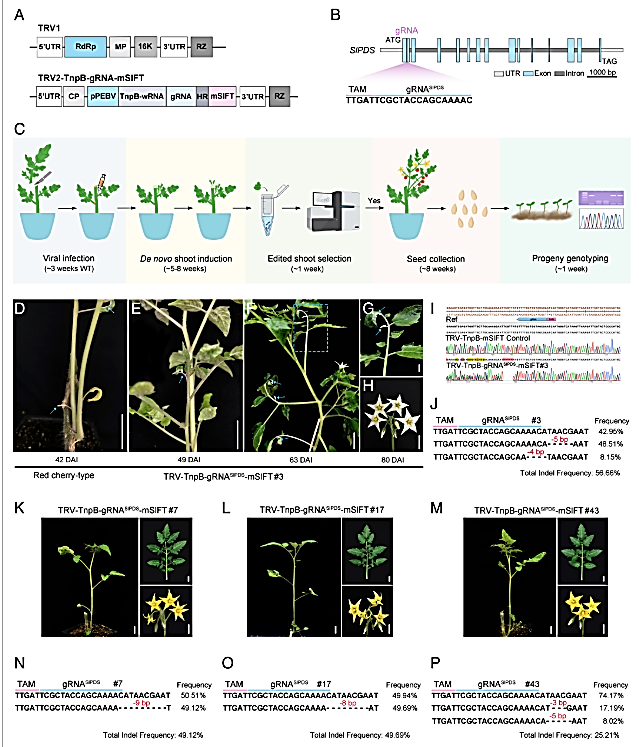
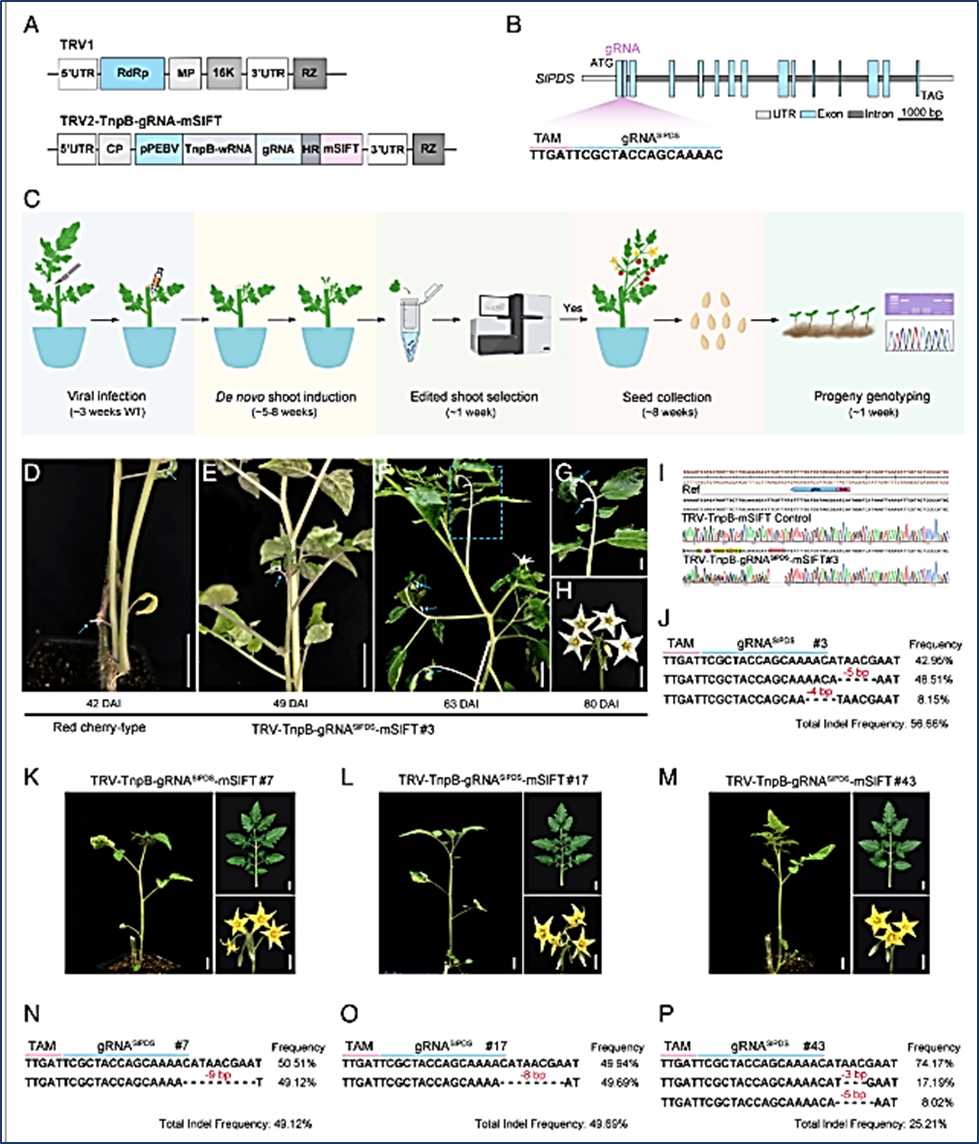
Figure 1:
Virus-induced genome editing in de novo shoots of tomato using TRV-TnpB-gRNASlPDS-mSlFT. (A) Schematic diagram of the TRV1 and TRV2 plasmids. The tomato mutated FT mobility element (mSlFT) was fused to the 3’ end of the gRNA in TRV2. RdRp: RNA-dependent RNA polymerase; MP: Movement Protein; CP: Coat Protein; pPEBV: Pea Early Browning Virus subgenomic promoter; HR: HDV Ribozyme; mSlFT: mutated tomato FT mobility element. (B) Schematic representation of SlPDS genomic structure. The light blue box represents exons, light gray represents the UTR sequence, and dark gray represents introns. The TAM sequence and target sequence are highlighted by the pink and blue lines, respectively. (C) The procedure for TRV-TnpB-gRNA-mSlFT-mediated genome-editing system in tomato plants. Edited de novo shoots were screened and validated by Sanger and NGS amplicon sequencing. (D–H) Different growth stages of TRV-TnpB-gRNASlPDS-mSlFT#3 plant displaying albino sectors in leaves and flowers. White leaflets in leaves are indicated by blue arrows, and the flowers exhibited white petals (H). (G) is a close-up view of (F); DAI: Days After Injection. (Scale bar, 1 cm.) (I) Sanger sequencing of the SlPDS gene target site in TRV-TnpB-mSlFT Control (Top) and TRV-TnpB-gRNASlPDS-mSlFT#3 (Bottom) plants. (J) Indel frequency analysis of the SlPDS gene in the TRV-TnpB-gRNASlPDS-mSlFT#3 shoot. Genomic DNA was extracted from green leaf tissue and subjected to amplicon sequencing using NGS. The TAM sequence and target sequence are highlighted by the pink and blue lines, respectively. Deleted nucleotides are marked by black dotted lines. The different indel types are shown on the Left. The percentage of reads corresponding to each indel type is shown on the Right. The total indel efficiency was calculated by the total number of indel reads divided by total number of reads. (K–M) Phenotype of the TRV-TnpB-gRNASlPDS-mSlFT#7 (K), #17 (L) and #43 (M) shoots, respectively, showing no obvious albino sectors. Images include the whole plant (Left), a leaf (Top Right), and flowers (Bottom Right). (Scale bar, 1 cm.) (N–P) Indel frequency analysis of the SlPDS gene from the TRV-TnpB-gRNASlPDS#7 (N), #17 (O), and #43 (P) shoots. The reads of sequences with frequencies >5% are shown as well as the total indel frequency.
Views: 321