


Trehalose-6-phosphate phosphatase-mediated trehalose metabolism shapes sorghum grain domestication for brewing adaptation
Wenzhen Li, Ning Cao, Yanqing Ding, Jianxia Xu, Xu Gao, Bin Cheng, Jichao Zhang, Shangfeng Wang, Ruoruo Wang, Kuiyin Li, Shengjun Li & Liyi Zhang
Theoretical and Applied Genetics; June 17 2026; vol.139; article 181
Abstract
Grain length-to-width ratio (GLWR) is a crucial trait influencing sorghum grain quality, particularly in brewing applications such as Baijiu production. However, the genetic basis of GLWR remains poorly understood. Here, we performed a genome-wide association study (GWAS) on 255 Chinese sorghum accessions and identified a gene, encoding trehalose-6-phosphate phosphatase, named SbTPP1, as a principal modulator of GLWR. Population structure analysis revealed three distinct subgroups, with Chishui subgroup exhibiting the roundest grains. SbTPP1, located on chromosome 7, contains 2 InDels and 5 SNPs in the coding sequence that differentiate long-grain and round-grain alleles, which shows strong selection signatures in Chishui germplasm and higher expression in round-grain accessions. Overexpression of SbTPP1 in transgenic sorghum significantly increased GLWR but reduced thousand grain weight. Haplotype analysis of 737 global sorghum accessions traced the round-grain allele (Hap1 and Hap3) to African origins, while the long-grain allele (Hap2) arose during sorghum’s migration to China. This study establishes SbTPP1 as a candidate gene controlling GLWR underlying grain shape variation and population-specific selection in Chinese sorghum, via the trehalose metabolism pathway. These insights provide molecular insights into sorghum grain shape determination and offer valuable genetic markers for breeding programs aimed at optimizing grain morphology for industrial uses.
See https://link.springer.com/article/10.1007/s00122-026-05279-6
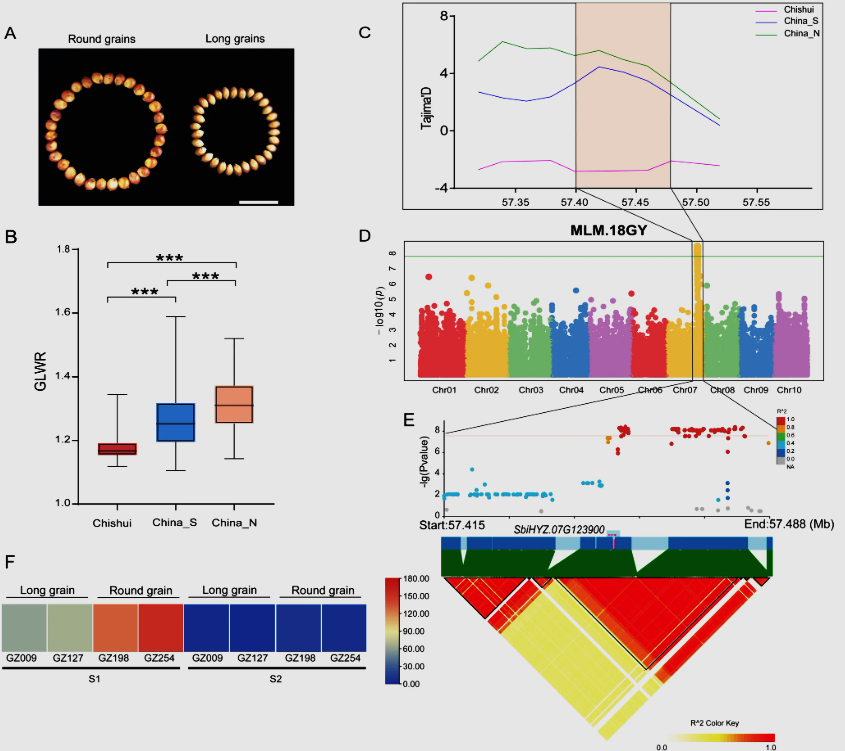
Figure 3: Candidate gene for GLWR based on GWAS analysis. A Phenotypic difference between round-grain (GZ250) and long-grain (GZ009) accessions. Scale bars, 1.5 cm. B Comparisons of grain aspect ratio among South, North, and Chishui populations. The Chishui sorghum exhibits significantly the roundest seeds among three Chinese populations (***P < 0.0001, Student’s T test). C Selective sweeps region for grain aspect ratio based on Tajima’s D values among the South population, North population, and Chishui population. D Manhattan plots for grain aspect ratio using phenotype data from the 255-accession panel in Guiyang in 2018. E Local Manhattan plot (upper) of grain aspect ratio and linkage disequilibrium (LD) heat map (lower). F Expression pattern of total candidate gene in GZ009, GZ127 (long grain) and GZ198, GZ254 (round grain) in various stages using transcriptome sequencing: S1, 10 days post-anthesis; S2, 20 days post-anthesis
Views: 113