


Genetic basis of cadmium accumulation and tolerance in maize seedlings uncovered through integrated linkage mapping and transcriptome analysis
Mutian Gao, Haibin Tang, Zhijie Liao, Yanmei Xiao, Wei Jia, Yong Chen, Hui Tan, Liusheng Zhong, Zijing Tang, Hongbing Luo, Zhili Wang & Cheng Huang
Theoretical and Applied Genetics; June 14 2026; vol. 139; article 180
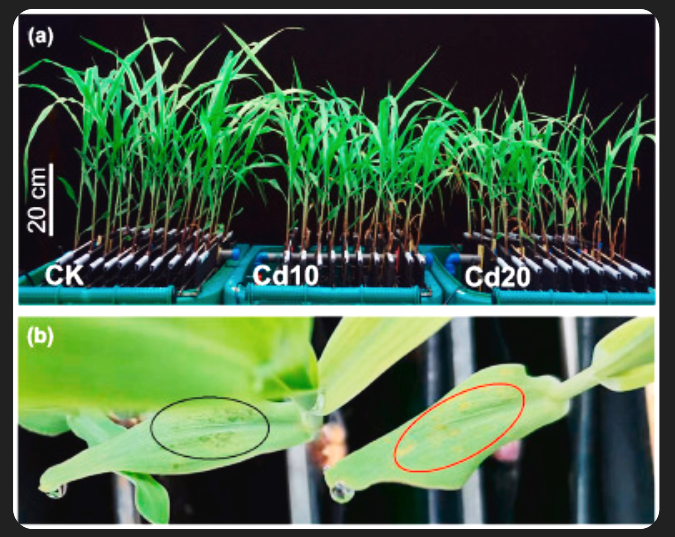
Figure: Cd in maize seedlinds
ABSTRACT
Twenty-seven favorable teosinte alleles reducing cadmium accumulation or enhancing tolerance were identified across 44 QTLs, and three promising candidate genes for the qCCA3-3 locus were further screened through integrated RNA-seq and qRT-PCR.
Cadmium (Cd) contamination in agricultural soils poses serious threats to food security and human health through crop bioaccumulation. This study integrated quantitative trait locus (QTL) mapping in a large maize–teosinte BC2S3 recombinant inbred line population (866 lines genotyped with 19,838 single nucleotide polymorphism markers) with transcriptome profiling to dissect the genetic basis of Cd accumulation and tolerance in maize seedlings. A total of 44 QTLs distributed across all ten chromosomes were identified, each explaining 1.4–6.6% of phenotypic variance, with predominantly additive gene action (59% of QTLs). Notably, 27 favorable alleles derived from the wild progenitor teosinte (Zea mays ssp. parviglumis) were found to reduce Cd accumulation or enhance tolerance, demonstrating that maize wild relatives harbor valuable genetic diversity for stress adaptation. Near-isogenic lines validation confirmed that the teosinte allele at the qCCA3-3 locus simultaneously reduces Cd accumulation and enhances tolerance under Cd stress. Transcriptome integration prioritized 19 candidate genes for qCCA3-3, including a glutathione S-transferase (Zm00001d043344) and two WRKY transcription factors (Zm00001d043062 and Zm00001d043063). These findings provide validated QTL, elite genetic stocks, and candidate genes as practical resources for developing Cd-safe maize cultivars through marker-assisted and genomic selection strategies.
See https://link.springer.com/article/10.1007/s00122-026-05294-7
Views: 147