


Integrated Single-Cell and Spatial Transcriptomics Reveal Cell-Type-Specific Immune Regulatory Networks in Maize Responding to Southern Corn Rust
Qiongqiong Wang, Xinyan Sun, Yingchao Sun, Zeqiang Cheng, Zixiang Cheng, Shengbo Han, Ying Feng, Wenbo Yang, Huimin Li, Meichen Zhu, Xiaoling Wu, Jinghua Zhang, Jihua Tang, Honglian Li, Yanyong Cao, Canxing Duan, Yan Shi
Adv Sci (Weinh).; 2026 May; 13(27):e12295. doi: 10.1002/advs.202512295.
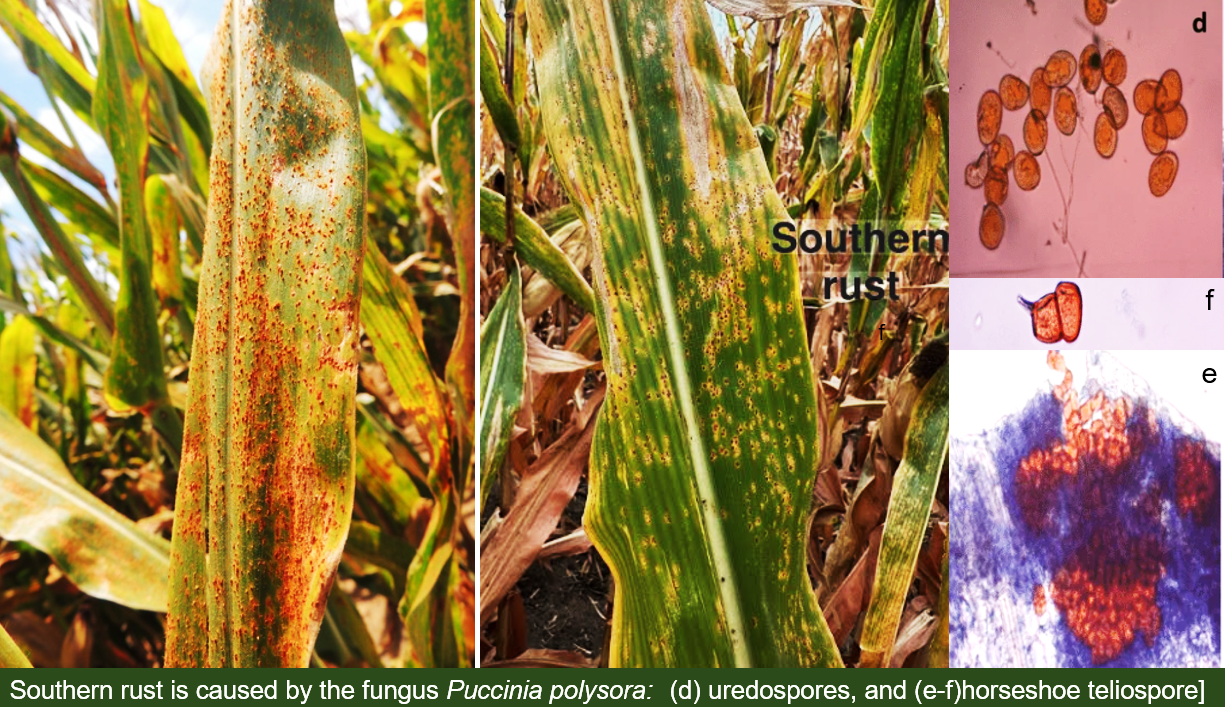
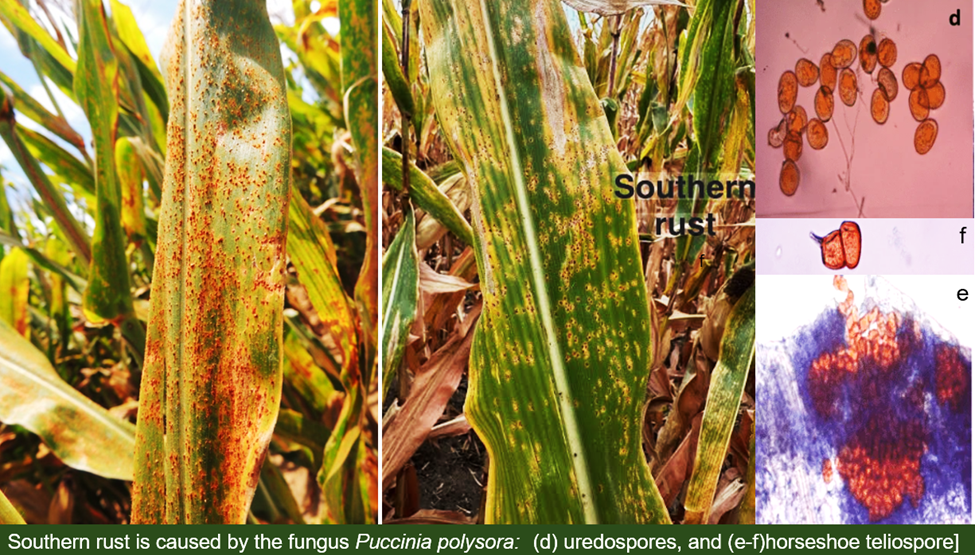
Figure: Southern rust maize symptom
Abstract
Southern corn rust (SCR), caused by Puccinia polysora Underw. (P. polysora), poses a significant threat to maize production, yet the cell-type-specific defense mechanisms remain insufficiently characterized. To address this, we integrated single-nucleus RNA sequencing (snRNA-seq) and spatial transcriptomic sequencing (stRNA-seq) to elucidate the cell-type-specific transcriptional dynamics in maize leaves during early infection with P. polysora. Analyses at 24 and 48 h post infection (hpi) revealed eight major cell types and highlighted key defense responses, which are primarily initiated in the mesophyll and epidermal cells 24 hpi. Notably, the cell-type-specific activation of RLPs/RLKs and jasmonic acid was observed. Functional defense modules were activated in specific cell types at 24 hpi, with pseudotime and cell-cell communication analyses further uncovering immune-related cellular dynamics. Importantly, multi-omics analysis identified core DEGs across critical cell types and time points. Functional validation through virus-induced gene silencing (VIGS) demonstrated that silencing the ZmXET1 gene significantly reduced disease severity and pathogen biomass, while silencing the positive regulator ZmRBG, increased susceptibility. This study provides a high-resolution spatiotemporal atlas of maize defense against P. polysora, identifying ZmXET1 as a key susceptibility factor and ZmRBG as a resistance component, thereby offering valuable targets for disease resistance breeding.
Views: 156