


Creating resistance to the whitefly Bemisia tabaci in cassava through RNAi-mediated targeting of multiple insect metabolic processes
Narayanan Narayanan, Rekha A R Swamy, Jackson Gehan, Tira Jones , Shelly Lazar, Dor Wintraube, Esther Yakir, Oren Hasson, Adam Lampert, John Colvin, Nigel J Taylor, Shai Morin, Osnat Malka
Front Plant Sci.; 2026 May 22: 17:1822258. doi: 10.3389/fpls.2026.1822258.

Abstract
Introduction: It is commonplace in East Africa for 100% of cassava fields to be infected with Cassava mosaic disease (CMD) and/or Cassava brown streak disease (CBSD), resulting in annual losses of more than US$1.25 billion and reduced food and economic security for farming households. The vector of both diseases is the African cassava species of the whitefly Bemisia tabaci. Since the late 1990s, there has been an unprecedented increase in whitefly populations, to the extent that they are referred to as "super-abundant". Research efforts since the late 1990s has focused mainly on developing plant resistance to the viral pathogens and paid scant attention to understanding the root causes of disease epidemics or the control of whitefly infestation.
Methods: Here, we aimed at developing long-term whitefly-control solutions using an in-planta RNA interference (RNAi) approach. First, transcriptome analysis identified candidate genes that play 'key' roles in whitefly biology: osmoregulation, sugar metabolism and transport, symbiosis with endosymbiotic bacteria and detoxification of phytotoxins. Then, fifteen RNAi inverted repeat constructs were produced, designed to target the candidate genes and 140 independent transgenic lines were generated in cassava variety NASE 13.
Results: Whole plant bioassays showed insecticidal activity of transgenic plants, reaching 58% lethality for adults within 7 days and 75-90% lethality of nymphs after 25 days, compared to control plants. Target genes were confirmed to be downregulated by up to 2.5-fold in adult whiteflies and nymphs.
Discussion: We used population dynamics modeling to predict the potential of the RNAi technology to control whiteflies under field conditions in East Africa. These analyses indicated that the developed technology offers a realistic option for obtaining durable control of cassava whitefly in African cassava fields.
See https://pubmed.ncbi.nlm.nih.gov/42255296/
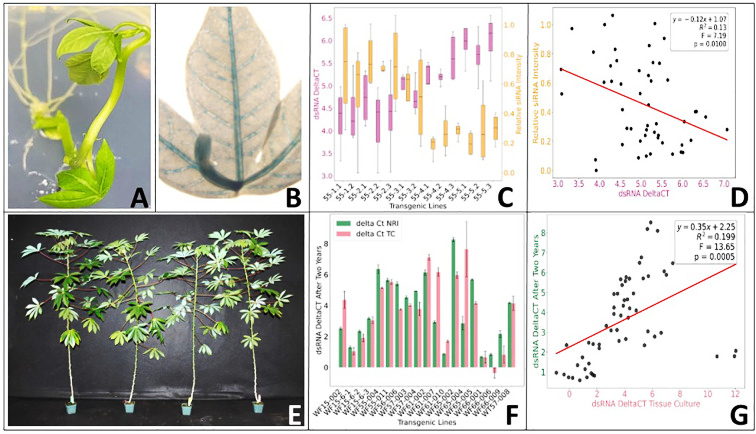
Figure 1
Production and analysis of insecticidal RNAi transgenic plants. (A) Transgenic plant in tissue culture. (B) The SUC2 promoter drives GUS expression to the vascular tissues of the leaves. (C) NASE 13 transgenic RNAi plants express both dsRNA and siRNA. (D) Higher dsRNA expression levels (lower Ct values – see section 2.6 for clarification) were found to be significantly correlated with higher accumulation of siRNA. (E) 12 weeks old NASE 13 transgenic RNAi plants display normal phenotype. Plants were grown on the open greenhouse bench under conditions of 28 °C/27 °C day/night temperatures and 70–95% relative humidity. (F) Stable expression of dsRNA in NASE 13 transgenic RNAi plants over two years (delta Ct NRI = two years old plants; delta Ct TC = young tissue culture plants). (G) Significant positive correlation between expression levels of dsRNA constructs over two years. Error bars represent standard errors of the mean. Linear association between siRNA and delta Ct values or between delta Ct values were evaluated using regression analysis. Statistical significance was assessed using a two-tailed test, and were considered significant at P ≤ 0.05.
Views: 195