


Bacterial metabolism rather than necromass dominates input to soil organic carbon
Annette Dathe, Laurel Lynch, Dominic Woolf, and Johannes Lehmann
PNAS; June 16, 2026; 123 (25) e2527157123; https://doi.org/10.1073/pnas.2527157123
Significance
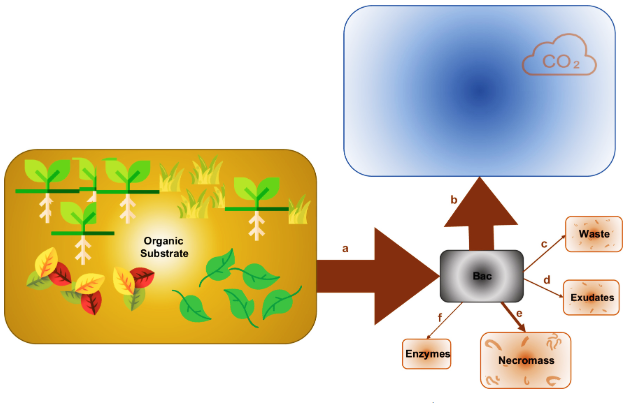
Our results highlight the need to account for diverse metabolic pools when estimating bacterial carbon inputs to soil organic matter beyond bacterial necromass alone. These findings have direct implications for calculating carbon use efficiency, a key parameter in many climate models and important in engineered microbial systems. Consequently, predictions and management of soil organic carbon accrual should consider all pathways of carbon input not limited to necromass.
Abstract
Soil organic carbon (OC) sequestration is presumed to rely to a large extent on microbial transformation of plant residues into microbial necromass. Necromass formation, however, represents only one pathway by which microorganisms contribute to soil organic matter, while OC released through metabolism is often neglected. Using a dynamic modeling approach, we show that exudates and waste products contribute about equally to bacterially derived OC inputs to soil with median contributions of 10% each (95% CI of 0.5 to 73% and 0.6 to 71%, respectively). Exoenzymes contribute an additional 15% (5 to 41%) and necromass contributes 49% (5 to 84%) to bacterial products. Overall, 6% (2 to 27%) of the organic input is released into the soil as bacterial metabolites (exoenzymes, exudates, and waste products), and the same amount as bacterial necromass 6% (8 to 20%). Exudates and waste products are typically composed of small reactive compounds that differ greatly from necromass in their molecular properties and will therefore likely contribute disproportionally to long-term soil OC accrual.
See https://www.pnas.org/doi/10.1073/pnas.2527157123
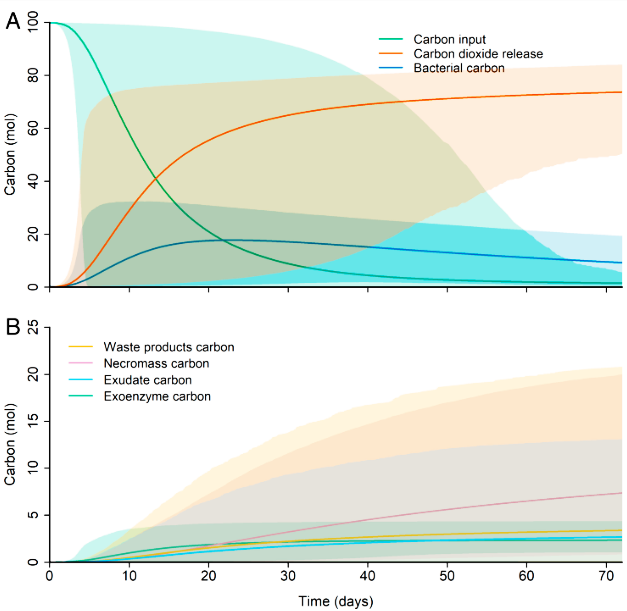
Figure 2
Microbial production of metabolites relative to necromass in soil—C pools. Model result over 72 d, the base simulation (SI Appendix, Table S2) shown as lines, and ranges of the 95% CI shown as shades (MC Simulation, 10,000 iterations). (A) Substrate C remaining, cumulative CO2 production, and C in living bacteria. (B) Cumulative organic products released by bacteria. Model result for N in SI Appendix, Fig. S1. Molar C:N = 20 for the organic substrate.
Views: 320