


Genome-edited rice variety with low-cadmium accumulation in the grain
Sheng Huang, Noriyuki Konishi, Weicai Chen, Naoki Yamaji, Jun Ge, Xiangbing Meng, Yanhui Jing, Yonghong Wang, Wenguang Wang, Hong Yu, Jian Feng Ma, and Jiayang Li
PNAS; June 18, 2026;123 (25) e2610609123 ; https://doi.org/10.1073/pnas.2610609123
Significance
Cadmium (Cd) is a highly toxic heavy metal. Rice is a major dietary source of Cd intake, thus reducing Cd accumulation in rice grains is an important challenge. However, balancing low Cd without yield penalty has proven difficult. This is because Cd shares transporters with essential metals. Here, through precise genome editing, we identified a point mutation in a major Mn/Cd transporter OsNramp5, which led to a significant reduction in grain Cd accumulation without compromising yield and accumulation of essential metals. This results from enhanced selectivity of OsNramp5 for zinc, which reduced Cd translocation due to competitive inhibition. These findings reveal a molecular mechanism underlying low Cd accumulation and provide a promising strategy for breeding low-Cd rice varieties.
Abstract
Cadmium (Cd) is a toxic and carcinogenic heavy metal, and rice, as a staple food, is a major source of dietary Cd intake. Therefore, limiting the transfer of Cd from soil to rice grain without compromising grain yield is a critical issue for human health. In this study, through base-editing-mediated mutagenesis screening targeting OsNramp5, a major transporter gene for manganese (Mn) and Cd uptake, we identified a single amino acid substitution at position 441 (Ile to Thr) that significantly reduced Cd accumulation in both shoots and grains without affecting the accumulation of other essential metals. Functional analysis revealed that this point mutation did not alter gene expression, protein abundance, subcellular localization, or Cd and Mn transport activity in yeast. However, we found that OsNramp5 also transports zinc (Zn), and the point mutation increased its selectivity for Zn. It is likely that elevated Zn levels in root cells competitively inhibit Cd release into the xylem, thereby reducing root-to-shoot Cd translocation. A field trial confirmed that the mutated OsNramp5 did not affect grain yield or essential micronutrient concentration but significantly decreased Cd accumulation in grains. Our findings suggest that precise editing of this key residue in OsNramp5 offers an effective strategy to reduce Cd transfer from soil to rice grain without yield penalty.
See https://www.pnas.org/doi/10.1073/pnas.2610609123
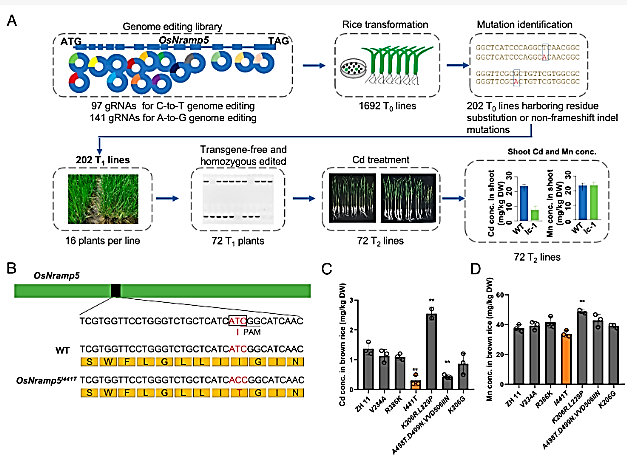
Figure1
Base editing-mediated saturation mutagenesis of OsNramp5. (A) Schematic illustration showing the process of screening low-cadmium accumulation mutants by base editing-mediated saturation mutagenesis. (B) Genotypes of OsNramp5I441T mutant. The mutated nucleotides are labeled in red for OsNramp5I441T. Protospacer Adjacent Motif (PAM) sequences are underlined. (C and D) Concentrations of Cd (C) and Mn (D) in the grains of selected lines. All lines were grown in a nutrient solution containing 0.5 µM Cd until maturity. The concentrations of Cd and Mn in the grains were determined by ICP-MS. Data are means ± SD of three biological replicates. Asterisks show a significant difference when compared with the wild-type rice (cv. ZH11) by Student’s t test (**P < 0.01).
Views: 188