


Integrated omics analysis on organic fertilizer-mediated regulation of starch synthesis in cassava
Jiongyu Chen, Zizhou Huang, Lijun Wei, Kaiwen Lei, Di Wang, Ruirui Chen, Ping Lv, Benchi Yu, Saiqing Lu
Front Plant Sci.; 2026 Jun 1: 17:1821836. doi: 10.3389/fpls.2026.1821836.
Abstract
Cassava (Manihot esculenta Crantz) is a vital food security crop and industrial feedstock worldwide. Although the excessive use of chemical fertilizers threatens soil health and sustainable agriculture, organic amendments provide an environmentally friendly alternative. In this study, organic fertilizer (chicken manure) was set as treatment and chemical fertilizer as control. The regulatory mechanisms of mature cassava starch synthesis were initially elucidated by integrating agronomic traits, physiological indices, and transcriptome-metabolome analyses. The results showed that organic fertilizer significantly enlarged the leaf xylem cell area, effectively promoting nutrient uptake and utilization. It also markedly improving leaf photosynthetic assimilation and root starch synthesis. Ultimately, organic fertilizer increased cassava yield by 13.72%-26.08% and starch content by 9.90%-11.21%. Combined omics analysis revealed that organic fertilizer modulates stress-related pathways through multiple mechanisms, including elevated levels of caffeoylshikimic acid and caffeoylquinic acid, upregulating genes related to glutathione metabolism, and downregulating β-1, 3-glucanase genes. In conclusion, organic fertilizer promotes photosynthetic assimilation and starch synthesis in cassava through multiple mechanisms. These effects lead to simultaneous increases in storage root yield and starch content.
See https://pubmed.ncbi.nlm.nih.gov/42306429/
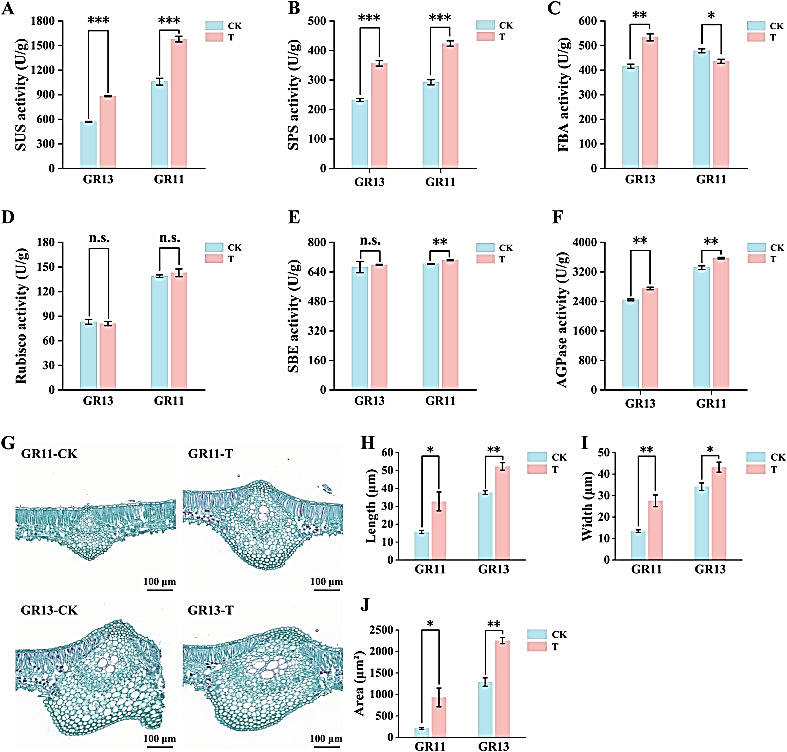
Figure1
Effects of organic fertilizer treatment on starch synthesis-related enzyme activities and leaf anatomical structure in GR11 and GR13. Activities of SUS (A), SPS (B), FBA (C), and Rubisco (D) in the leaves of GR11 and GR13; Activities of SBE (E) and AGPase (F) in their tuberous roots. (G) Paraffin section micrographs of leaves from GR11 and GR13 under different treatments. Quantitative analyses of xylem cell length (H), width (I), and area (J). Values are presented as mean ± SE. Fisher’s LSD test was used for multiple comparisons, *p < 0.05, **p < 0.01, ***p < 0.001; n.s., no significant difference (p > 0.05).
Views: 102