


Selection of four mutant alleles of fatty acid desaturase genes for a stable high oleic and low linolenic acid soybean seed oil trait
Hyun Jo, Aaron Lorenz, Brian Diers, Andrew Scaboo, Vincent Pantalone, Zenglu Li & Kristin Bilyeu
TAG; June 24 2026; vol. 139; article 189
Key message
The combination of four variant fatty acid desaturate alleles achieves the desired high oleic and low linolenic acid fatty acid profile in soybean seed oil across U.S. production environments.
Abstract
Soybean is a global crop that represents over half of current world oilseed production. Soybean oil has been utilized in the food system based on the functional and health properties of the fatty acid profile; there is an urgent need to adjust the fatty acids in soybean oil to meet current market demands. The soybean high oleic acid seed oil trait (> 75%) in conjunction with a low linolenic acid trait (< 3%) has emerged as an avenue to improve the oil. The objective of this research was to identify a soybean genotypic group comprised of variant alleles of fatty acid desaturase genes that could meet the target stable seed oil fatty acid thresholds across the U.S. soybean production environments. New soybean genotypes were created with different gene combinations for seed oil fatty acid profile and maturity groups, seeds were produced in their target environments, and fatty acid profiles of the seeds were determined. The results demonstrated that a four-gene combination in soybean genotypes using either of two variant versions of one of the genes achieved both the target thresholds in environments across the U.S. soybean production regions. There were significant differences in individual fatty acid levels in the seed oil when comparing the two four-gene genotypic groups. The impact of this work is the new knowledge to design soybean varieties for U.S. production environments with seed oil fatty acid profiles targeted to meet current market thresholds; the fatty acid profiles obtained can serve as the basis for improved products.
See https://link.springer.com/article/10.1007/s00122-026-05302-w
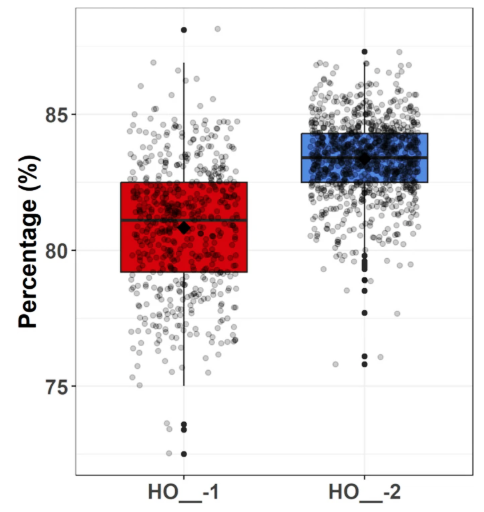
Figure 1: All environment comparison of seed oil oleic acid phenotypes between high oleic samples with the missense or null alleles of FAD2-1A. The percentage of oleic acid in the seed oil is presented in the box and whisker plots for HO__-1 (red box; missense S117N FAD2-1A with missense P137R FAD2-1B; all FAD3 allele status included) lines and HO__-2 (blue box; null indel FAD2-1A with missense P137R FAD2-1B; all FAD3 allele status included) lines ignoring the FAD3A and FAD3C allele status. The means are indicated with filled diamonds, the median line transects each box, the quartiles are represented by the upper and lower margins of the box, the whiskers represent range in values, outliers are indicated with black circles, and the individual sample values are represented with gray circles
Views: 107