


Optimising realised genetic gain with low forward predictive ability across cycles for cooking time and correlated traits in common bean based on multivariate genomic selection
Renu Saradadevi, Winnyfred Amongi, Clare Mukankusi, Allan S. Male, Jean-Claude Rubyogo, Eric Huttner, Felipe A. Castro-Urrea, Li Li, Kadambot H. M. Siddique & Wallace A. Cowling
TAG; June 19 2026; vol. 139; article 183
Abstract
Key message
Rapid genetic gain was achieved for cooking time in common bean based on multivariate genomic analysis, but forward predictive ability was low and phenotyping remains essential to secure genetic gain.
Abstract
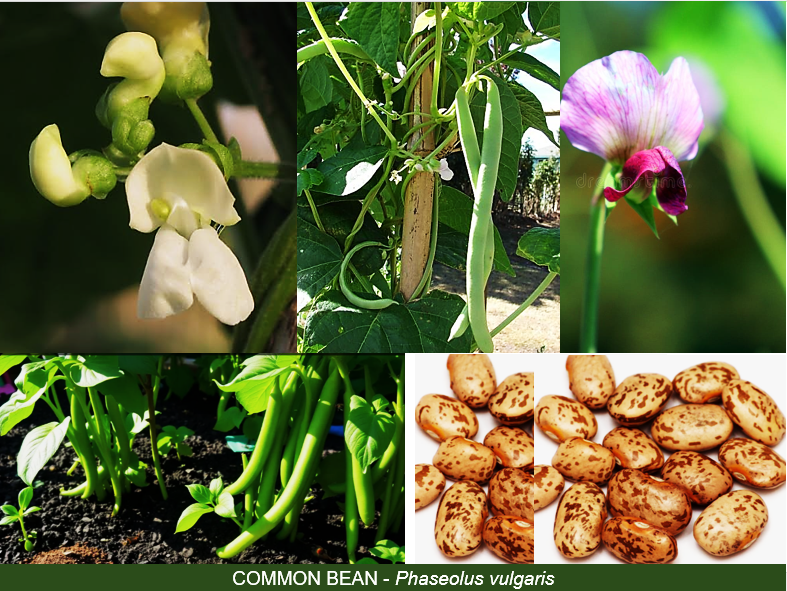
Common beans (Phaseolus vulgaris L.) are a major source of protein and energy in sub-Saharan Africa, but their long cooking time (CKT) imposes social, economic, environmental and health burdens. This study aimed to accelerate genetic gain for shorter CKT while maintaining or improving other seed traits such as seed iron (Fe) and zinc (Zn) content, water absorption capacity (WAC) and 100-seed weight (SW100) across rapid cycles of early-generation genomic selection. Two related founder populations were selected from the African bean panel and intercrossed in 2020 (population A) and 2021 (population B), followed by rapid two-year cycles of augmented S0-derived family selection based on an index and optimal contributions selection. Best linear unbiased predictions (BLUPs) of breeding values were obtained from pedigree (ABLUP), genomic (GBLUP) and single-step (HBLUP) multivariate linear mixed model analysis across two cycles. Realised genetic gain from cycle 1 to cycle 2 was high for CKT (average -8.0 min y−1) and favourably correlated with WAC (average + 7.7% y−1), but detrimental genetic correlations limited gain in Fe, Zn and SW100. Genomic and single-step models resulted in high accuracy of BLUPs based on prediction error variance. Forward predictive ability for CKT across cycles was low, but rank correlation of realised and predicted HBLUPs for CKT in cycle 2B S0 seedlings was moderate-high (0.734) when phenotypes for Fe, Zn, WAC and SW100 in cycle 2B were included in the analysis. Desired genetic gains in CKT, Fe and Zn in future cycles will require high levels of phenotyping in each cycle, although easy-to-measure correlated traits such as WAC and SW100 may assist genetic gain in all traits.
See https://link.springer.com/article/10.1007/s00122-026-05263-0
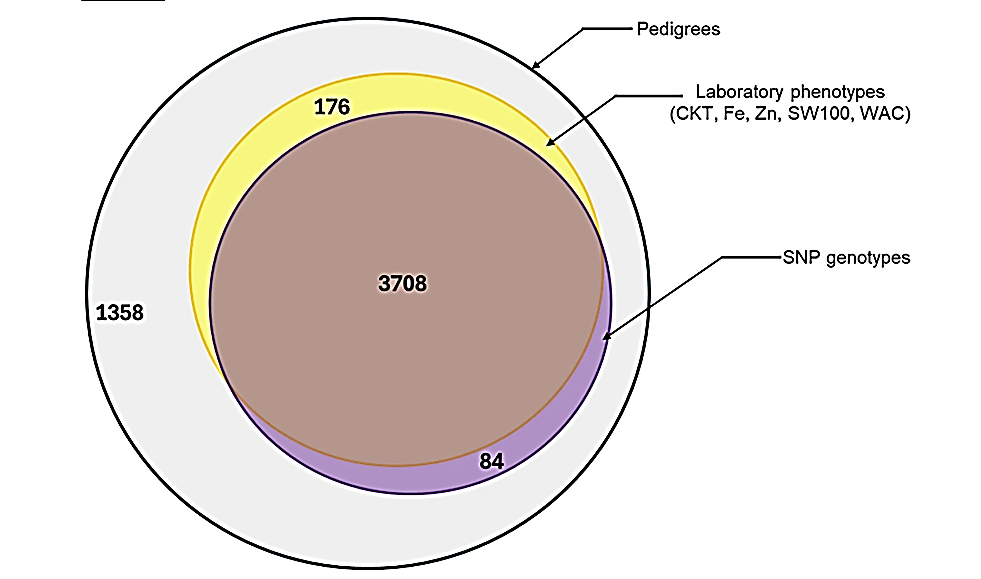
Fig. 3
From: Optimising realised genetic gain with low forward predictive ability across cycles for cooking time and correlated traits in common bean based on multivariate genomic selection.
Venn diagram showing number of common bean individuals in the breeding programme combined across populations 1A, 1B, 2A and 2B with pedigrees, SNP genotypes, and laboratory-based phenotypes for cooking time (CKT), iron (Fe), zinc (Zn), 100-seed weight (SW100) and water absorption capacity (WAC)
Views: 141