


Rapid cycling genomic selection in maize landraces: a step toward closing the yield gap
Carolina Rivera-Poulsen, Clara Polzer, Armin C. Hölker, Thomas Presterl, Sofia da Silva, Michelle Terán-Pineda, Milena Ouzunova, Albrecht E. Melchinger & Chris-Carolin Schön
Theoretical and Applied Genetics; December 15 2025; vol. 139; article 5
Key message
Rapid cycling genomic selection is a highly efficient tool for pre-breeding of maize landraces for complex traits, especially in combination with multi-trait selection and model retraining.
Abstract
The introduction of landrace-derived material into modern breeding programs can only succeed if it performs satisfactorily for yield and other key agronomic traits. In this study, we explored the prospects of rapid cycling genomic selection in maize (Zea mays L.) to accelerate pre-breeding of landraces in comparison with recurrent phenotypic selection. We performed three cycles of genomic selection for testcross performance. The selection criterion was based on directional selection for biomass yield and stabilizing selection for plant height and flowering time. The prediction model was trained on testcrosses of 419 doubled-haploid (DH) lines derived from two European landraces. To estimate selection response and prediction accuracies, DH lines from all cycles (N = 204, C0–C3) were evaluated together with seven commercial hybrids in seven environments. Selection narrowed the yield gap to the commercial hybrids significantly with an increase in dry matter yield of about 10% in comparison with the reference population (C0). Despite stabilizing selection for plant height and flowering time, both traits showed a correlated response with biomass yield pointing to the importance of optimizing multi-trait selection, especially in landraces. Prediction accuracies were intermediate to high in the training population and decreased in the following cycles. Retraining the prediction model increased the prediction accuracy for all traits. Our results support the hypothesis that pre-breeding can be accelerated significantly by rapid cycling genomic selection and give valuable insights into key factors determining its success.
See https://link.springer.com/article/10.1007/s00122-025-05107-3
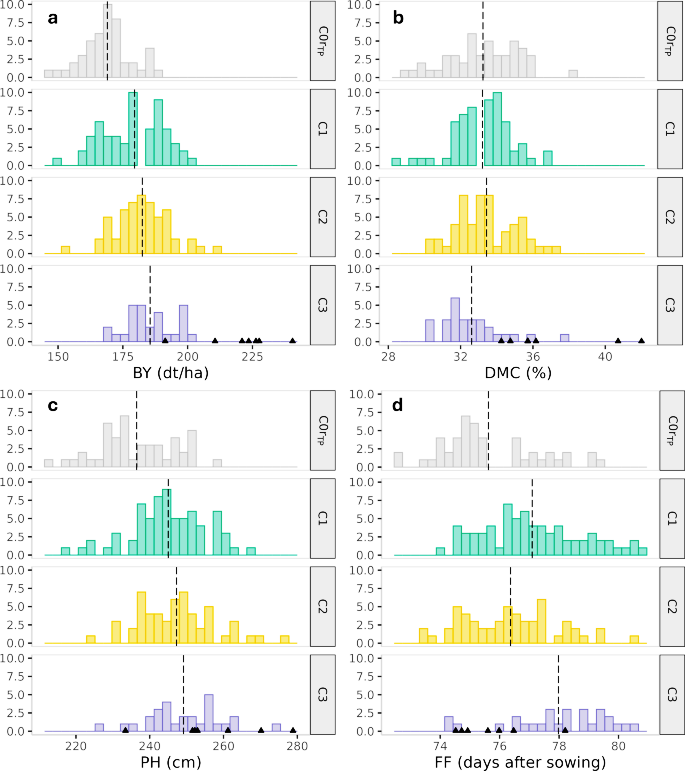
Figure 1:
Distributions of adjusted entry means for DH lines from populations C0rTP to C3 for testcross performance of a biomass yield (BY), b dry matter content (DMC), c final plant height (PH), and d female flowering (FF). Vertical dashed lines indicate the respective population mean. Triangles along the x-axis indicate the adjusted means of the seven commercial check hybrids
Views: 145