


Nitrate-induced NLP1 SUMOylation regulates nitrate signaling and root nodulation
Jing Liu, Zhenpeng Luo, Jiang Wang, Jieshun Lin, and Fang Xie
PNAS; January 23, 2026; 123 (4) e2518288123; https://doi.org/10.1073/pnas.2518288123

Figure: Medicargo truncata root nodulation
Significance
Legume nodulation enables biological nitrogen fixation but is strongly repressed by nitrate. NIN-like proteins (NLPs) mediate this nitrate response, yet how their activity is regulated remains unclear. Here, we demonstrate that SUMOylation—a reversible posttranslational modification—is essential for the transcriptional activity and protein–protein interactions of MtNLP1 in Medicago truncatula, independently of its nitrate-induced nuclear localization. This modification is conserved in other NLPs, including Arabidopsis thaliana NLP7. Moreover, knockdown of SUMOylation-machinery components disrupts nodulation, suggesting that additional regulators in the symbiotic pathway also depend on SUMOylation. This work identifies SUMOylation as a conserved regulatory mechanism integrating nitrate signaling with root nodule symbiosis, with broad implications for improving plant nitrogen use efficiency.
Abstract
Nitrate serves both as an essential nutrient and a key signaling molecule that shapes plant growth. In legumes, high nitrate concentrations suppress symbiotic nitrogen fixation, a process mediated by MtNLP1 (NIN-like protein1). Although nitrate minimally affects NLP transcript levels, it strongly controls their nuclear localization. How posttranslational modifications regulate MtNLP1 function, however, has remained unclear. Here, we show that nitrate induces SUMOylation of MtNLP1 at lysine 589 and 795 and that this modification is essential for its biological activity. Loss of these SUMO sites compromises nitrate-mediated inhibition of nodulation and weakens MtNLP1 interactions with MtNIN and itself. Components of the SUMOylation machinery in Medicago truncatula physically interact and are essential for both nodulation and nitrate responsiveness, indicating broader roles for SUMOylation in symbiosis. A SUMO-deficient Arabidopsis thaliana AtNLP73KR mutant fails to complement the Atnlp7-1 phenotype, demonstrating that SUMOylation is a conserved regulatory mechanism among NLPs. Together, our findings reveal SUMOylation as a previously unrecognized layer of regulation that integrates nutrient signaling with root nodule symbiosis.
See: https://www.pnas.org/doi/10.1073/pnas.2518288123
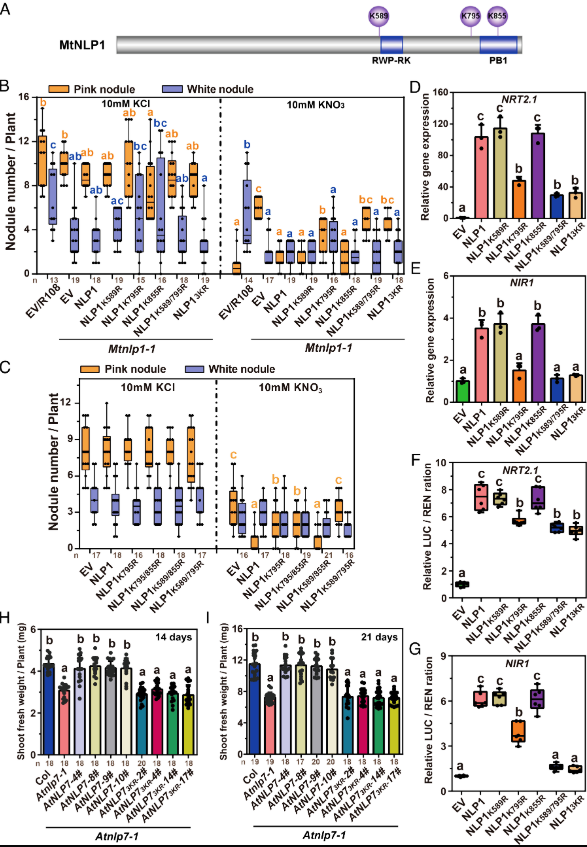
Figure 1:
SUMOylation of MtNLP1 is essential for its function in nodulation and nitrate signaling. (A) Schematic of the MtNLP1 protein showing the RWP-RK and PB1 domains (blue) and predicted SUMOylation sites (K589, K795, and K855). (B and C) Nodule numbers on Mtnlp1-1 hairy roots expressing empty vector (EV), wild-type MtNLP1, or SUMO-deficient MtNLP1 variants at 2 wk postinoculation (wpi) with rhizobia under 10 mM KCl or KNO3 treatment. Letters denote significant differences between samples (Two-way ANOVA, Tukey's multiple comparisons test, P < 0.05). (D and E) Relative expression levels of MtNRT2.1 and MtNIR1 in Mtnlp1-1 roots expressing EV, MtNLP1, and SUMO-site mutants following 4 h of 10 mM KNO3 treatment. Plants were pregrown on FP medium for 7 d (n = 3, independent biological replicates, each with 6 to 10 plants). Error bars represent SD. (F and G) Dual-luciferase reporter assays examining transcriptional activation of MtNRT2.1 and MtNIR1 promoters by MtNLP1 or SUMO-deficient variants in Nicotiana benthamiana leaves, with nitrate treatment. EV serves as a negative control. LUC activity is normalized to REN activity. n = 6. (H and I) Shoot fresh weight of wild-type (Col-0), Atnlp7-1, and complemented lines expressing AtNLP7 or AtNLP73KR in Atnlp7-1 grown on MGRL medium with 5 mM KNO3 for 14 d (H) or 21 d (I). Error bars indicate SD. In D-I, different letters denote significant differences (One-way ANOVA, Tukey's multiple comparisons test, P < 0.05). “n” represents the sample size.
Views: 246