


Inter-plot competition in hybrid maize multi-environment yield trials in Ethiopia can reduce rate of genetic gain
Tolera Keno, Emma Mace, Ian Godwin, David Jordan & Alison Kelly
Theoretical and Applied Genetics; June 9 2026; vol. 139; article 174
Key messages
The use of a competition model in the analysis of yield data from single-row hybrid maize METs improves the accuracy of genotype selection and thus the rate of genetic gain, while it ensures resource use efficiency in resource-constrained breeding programs.
Abstract
Conducting large-scale multi-environment trials (METs) is practically challenging to breeding programs in Sub-Saharan Africa due to limitations of land, seed, and associated costs of phenotyping. As a result, early-generation hybrid maize trials are usually planted in single-row plots. In trials with single-row plots, genotypes compete with their neighbors for resources, and this biases the prediction of the genotype value. We demonstrate the impact of inter-plot competition in single-row multi-environment hybrid maize trials in Ethiopia through a motivating example assessing subsets of 478 maize hybrids in six trials in the 2019 and 2020 seasons. The trials were planted in partially replicated design with single-row plots. Field spatial variability and inter-plot competition were jointly modelled in a linear mixed model framework to partition the total genetic effect into direct and neighbour effects. Both direct and neighbour genetic effects differed across the trials confirming the presence of genotype by environment interaction (GEI) for these genetic components. There was a rank change in genotype performance between the selections from the competition model in comparison to the standard MET model. The proportion of mismatch in the top 20% of the selected genotypes from the competition model and the standard MET model ranged from 20–70% across the optimum nitrogen sites and up to 90% in the low nitrogen site. The results demonstrated that inter-plot competition biases grain yield predictions in single-row plot hybrid maize METs and thus reduces the rate of genetic gain, where the effect is particularly marked in low nitrogen environments.
See https://link.springer.com/article/10.1007/s00122-026-05255-0
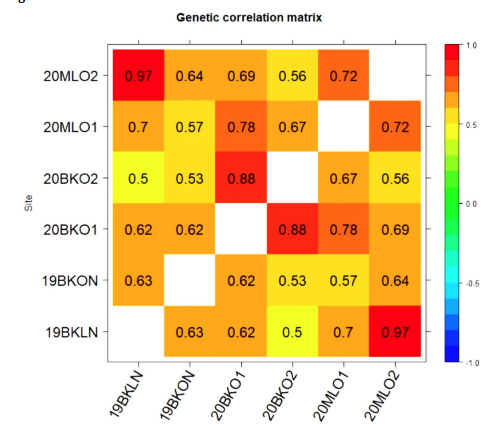
Figure 1: Genetic correlation between sites from the S-MET model for grain yield of maize hybrids tested at six sites in Ethiopia in 2019 and 2020
Views: 112