


Identification of nodule number-related loci and the candidate gene GmbHLH135 in soybean under low phosphorus stress
Shengqian Chao, Qing Wang, Xinyu Jiang, Weihao Zhang, Yun Chen, Xiaohan Ren, Kaiqiang Wang, Lifang Liu, Renzhong Fan, Wei Zhao, Deyue Yu & Hao Cheng
Theoretical and Applied Genetics; April 17 2026; vol. 139; article 125
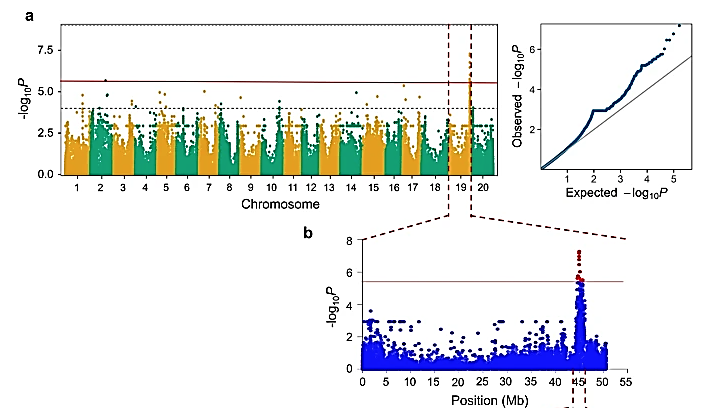
Figure: GWAS signal, haplotype block analysis of qPH19, and haplotype effect for plant height. (Bhat et al. 2022)
Abstract
Soybean plays a crucial role in meeting nitrogen demands through biological nitrogen fixation (BNF), a process highly dependent on phosphorus availability. Low-phosphorus (LP) stress significantly impairs nodule development, thereby affecting soybean growth and productivity. Genome-wide association study (GWAS) was conducted using the ratio of the nodule numbers (RNNs) under normal phosphorus condition and low-phosphorus condition in a natural population with 272 soybean accessions grown in three environments. A total of 21 novel single nucleotide polymorphisms (SNPs) related to nodule-related traits located on soybean chromosome 5 and chromosome 6 were repeatedly detected in two environments. Among them, 18 SNPs related to the ratio of the nodule number to the total plant weight under the normal phosphorus (NP) condition to that under the LP condition (RNP) formed a SNP cluster, and one SNP (AX-94275075) in this SNP cluster was detected simultaneously for multiple traits. A candidate gene, named GmbHLH135, which encodes a member of the basic helix-loop-helix (bHLH) family of transcription factors, was functionally characterized. The expression of GmbHLH135 was affected by low-phosphorus stress. Overexpressing and suppressing GmbHLH135 in soybean hairy roots resulted in a decreased and increased nodule number, respectively. GmbHLH135-overexpressing transgenic soybean lines presented decreased nodule number, brassinosteroids (BR) contents, plant biomass and yields. These findings could highlight the role of identified significant SNPs and the candidate gene GmbHLH135 in regulating nodule development under LP stress, provide valuable insights into the molecular mechanisms underlying phosphorus-mediated nodule growth and offer potential targets for soybean breeding.
See https://link.springer.com/article/10.1007/s00122-026-05233-6
Views: 135