


Ubiquitination of BAM1 attenuates CLE peptide–mediated signaling in the root apical meristem
Yuanyuan Zhou, Fei Liu, Yongfeng Han, Jiaojiao Bai, Baowen Zhang, Wenqiang Tang, Xiaoping Gou, Yan Zhang, and Dongping Lu
PNAS January 20, 2026; 123 (4) e2530116123; https://doi.org/10.1073/pnas.2530116123
Significance
The receptor kinase BARELY ANY MERISTEM1 (BAM1) drives phloem formation and regulates other aspects of root development. However, the mechanisms underlying BAM1 degradation remain unclear. Our study reveals that two closely related ubiquitin ligases, RING DOMAIN LIGASE 1 (RGLG1) and RGLG2, mediate the ubiquitination and degradation of BAM1. This process attenuates BAM1-mediated signaling in the root meristem.
Abstract
The plasma membrane-resident receptor-like kinases (RLKs) and their cognate peptide ligands play crucial roles in plant growth and development. The RLK BARELY ANY MERISTEM1 (BAM1) promotes phloem formation and regulates other aspects of root development. However, the mechanisms governing BAM1 protein degradation remain unclear. In this study, we demonstrate that two closely related ubiquitin ligases, RING DOMAIN LIGASE 1 (RGLG1) and RGLG2, specifically interact with BAM1 and its closest homolog BAM2. RGLG1/2 ubiquitinate BAM1/2 and mediate their degradation, thereby dampening BAM1/2 signaling. Treatment with the peptide CLE13 (CLV3/EMBRYO SURROUNDING REGION-RELATED 13) enhances the BAM1/2-RGLG2 interaction and the ubiquitin ligase activity of RGLG2, resulting in increased ubiquitination and degradation of BAM1/2 by RGLG1/2. The rglg1 rglg2 double mutant exhibits increased sensitivity to CLE13 compared to the wild type. Collectively, our findings demonstrate that RGLG1/2-mediated ubiquitination and degradation of BAM1/2 attenuate CLE13-mediated signaling in root meristem.
See https://www.pnas.org/doi/10.1073/pnas.2530116123
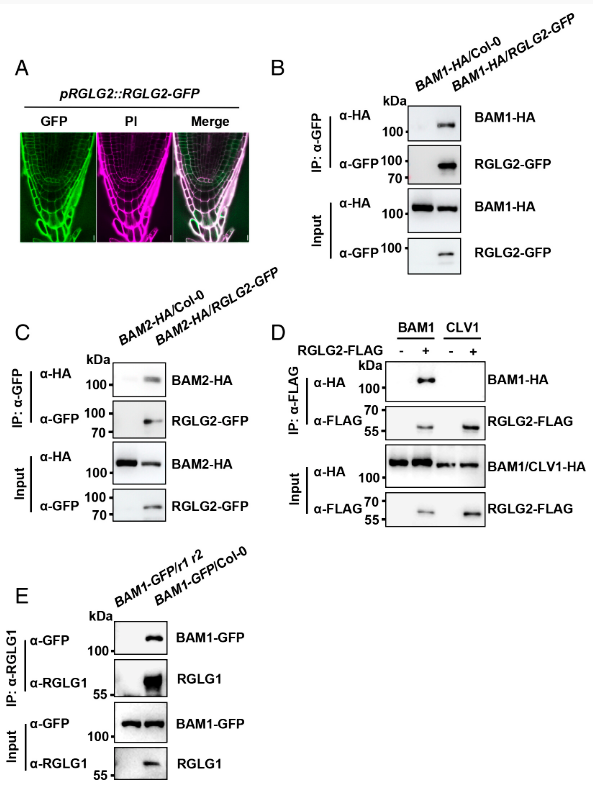
Figure 1: RGLG1/2 associate with BAM1/2. (A) RGLG2 is expressed in the RAM. The expression pattern of RGLG2 in the RAM was examined using the pRGLG2::RGLG2-GFP transgenic line. Shown are images of the GFP channel (Left), the RFP channel (PI staining, middle), and the merged GFP and RFP channels (Right). (Scale bar: 10 µm.) (B and C) RGLG2 is associated with BAM1/2 in stable transgenic plants. Seven-day-old p35S::BAM1/2-HA/pRGLG2::RGLG2-GFP and p35S::BAM1/2-HA/Col-0 seedlings were collected and total proteins were isolated. RGLG2-GFP was immunoprecipitated with anti-GFP magarose, the associated BAM1-HA proteins were detected by immunoblotting with anti-HA antibodies. (D) RGLG2 is not associated with CLV1 in protoplasts. RGLG2-FLAG was coexpressed with BAM1-HA or CLV1-HA in Arabidopsis protoplasts. Following IP with anti-FLAG antibodies, the associated proteins were detected by immunoblotting with anti-HA antibodies. (E) RGLG1 is associated with BAM1. p35S::BAM1-GFP/rglg1 rglg2 and p35S::BAM1-GFP/Col-0 seedlings were treated with 50 μM MG132 for 3 h. RGLG1 was immunoprecipitated with anti-RGLG1 antibodies, the associated BAM1-GFP proteins were detected by immunoblotting with anti-GFP antibodies.
Views: 160