


Sulfate Deficiency-Responsive MicroRNAs in Tomato Uncover an Expanded and Functionally Integrated Regulatory Network
Diego Landaeta-Sepúlveda, Nathan R Johnson, Jonathan Morales-Espinoza, Mariola Tobar, Evelyn Sánchez, José D Fernández, Consuelo Olivares-Yáñez, Joaquín Medina, Javier Canales, Elena A Vidal
Int J Mol Sci.; 2025 Aug 29; 26(17):8392. doi: 10.3390/ijms26178392.
Abstract
Sulfate availability critically influences plant growth, yet the role of small RNAs, particularly microRNAs (miRNAs), in regulating responses to sulfate deficiency remains poorly understood. Here, we conducted a temporal analysis of sulfate deficiency-responsive miRNAs in the roots and leaves of Solanum lycopersicum (tomato), using an updated miRNA annotation in the SL4.0 genome. We found 40 differentially expressed miRNAs, including 2 novel, tomato-specific miRNAs. Tomato miRNAs showed an important time- and organ-specific regulation, similar to the described response of the mRNA transcriptome. Integration with transcriptomic data and Degradome-seq analysis highlighted both canonical and non-canonical targets for sulfate-responsive miRNAs. miR395, the most extensively studied miRNA, was found to control not only its conserved targets involved in sulfate transport and assimilation, but also genes involved in redox homeostasis, photosynthesis and chloride transport. Notably, most targets were repressed in leaves, suggesting miRNA-mediated downregulation of energy-intensive processes, while root targets were predominantly upregulated, including genes related to protein remodeling and antioxidant defense. Comparative analysis with Arabidopsis thaliana revealed a broader functional repertoire in tomato, suggesting species-specific adaptations to sulfate deficiency. Overall, our results underscore the critical role of miRNAs in fine-tuning organ-specific metabolic reprogramming during nutrient stress, expanding the current understanding of the regulatory landscape underlying sulfate deficiency in plants.
See https://pubmed.ncbi.nlm.nih.gov/40943314/
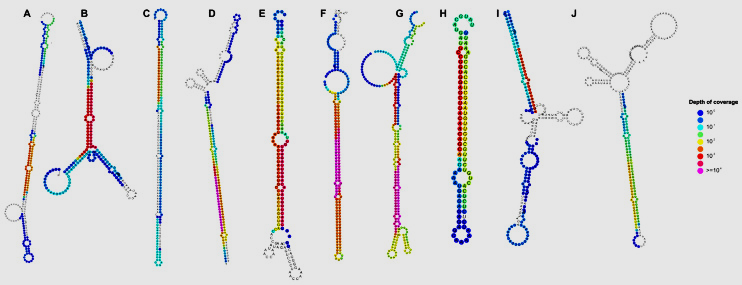
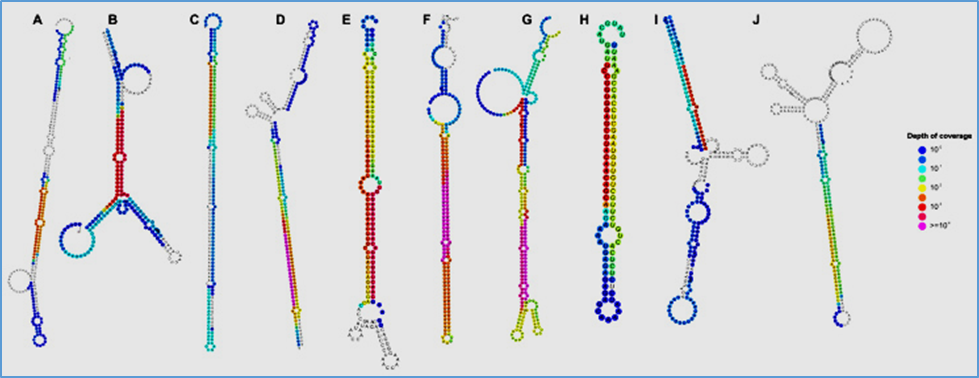
Figure 1: ShortStack analysis of sRNA species from leaves and roots of plants exposed to control and sulfate deficiency conditions identifies ten novel miRNAs. Solanum lycopersicum cv. Moneymaker seeds were germinated and grown in hydroponic medium containing modified basal 0.5 X Murashige and Skoog salts containing K2SO4 as sulfate source (control condition) or KCl (treatment, sulfate deficiency condition). Predicted hairpins from sRNA clusters passing all ShortStack tests for miRNA genes, and not annotated as a known miRNA, were extracted and their secondary structures were predicted using StrucVis 0.9 (https://github.com/MikeAxtell/strucVis, accessed on 10 October 2024). The color gradient shows the depth of alignment coverage. (A): sly-b4.0r1-14993_MIRNA; (B): sly-b4.0r1-14505_MIRNA; (C): sly-b4.0r1-21667_MIRNA; (D): sly-b4.0r1-25391_MIRNA; (E): sly-b4.0r1-59201_MIRNA; (F): sly-b4.0r1-60115_MIRNA; (G): sly-b4.0r1-66932_MIRNA; (H): sly-b4.0r1-83697_MIRNA; (I): sly-b4.0r1-96827_MIRNA; and (J): sly-b4.0r1-97328_MIRNA.
Views: 98