


Subfamily-level Comparative Transcriptomics of Key Immune Regulators in Plants and Suspension Cells Reveals Novel Rice Blast-resistance Genes
Wanqing Wang, Fumi Fukada, Tomoyuki Furuta, Alfino Sebastian, Kiwamu Hyodo, Natsuko Ono, Hideki Nishimura, Pingyu Wang, andYoji Kawano
Plant Cell Physiol.; 2026 Feb 10:pcag019. doi: 10.1093/pcp/pcag019. Online ahead of print.
Abstract
Plants activate pattern-triggered immunity (PTI) through key immune components, including pattern recognition receptors (PRRs), receptor-like cytoplasmic kinases (RLCKs), and transcription factors (TFs), to combat pathogens. However, a comprehensive transcriptional overview of these immune regulators at the subfamily level during biotic stress in rice is currently lacking. The aims of this study were to characterize the expression profiles of OsPRRs, OsRLCKs, and OsTFs and establish a robust pipeline for selecting novel candidate genes involved in plant immunity. We identified differentially expressed genes (DEGs) within these families using transcriptomic data from both rice plants infected with Magnaporthe oryzae infection and rice suspension cell treated with chitin treatment. Our analysis revealed the transcriptional regulation of well-known immune-related subfamilies of OsPRRs, OsRLCKs, and OsTFs, such as RLK-LRR-XII and RLCK-VII, and identified several novel subfamilies with high proportions of DEGs that may contribute to pathogen perception and plant defense. We demonstrated that selecting candidates from overlapping DEGs between plant and suspension cell systems is an effective strategy for screening genes involved in rice immunity. Using this pipeline, novel immune regulators were identified, and their functions were confirmed. Two RLCKs, i.e., OsRLCK298 and OsBSR1, act as positive regulators of immunity against rice blast fungus, whereas two transcription factors, i.e., OsERF65 and OsERF96.2, act as negative regulators. This study provides a valuable transcriptomic resource and establishes a validated pipeline for gene discovery that could be applied to other stress responses and in other plant species.
See: https://pubmed.ncbi.nlm.nih.gov/41665283/
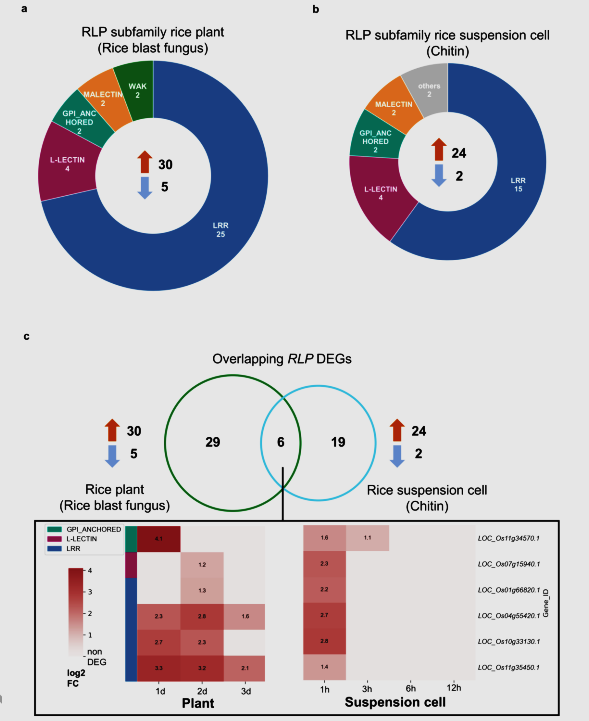
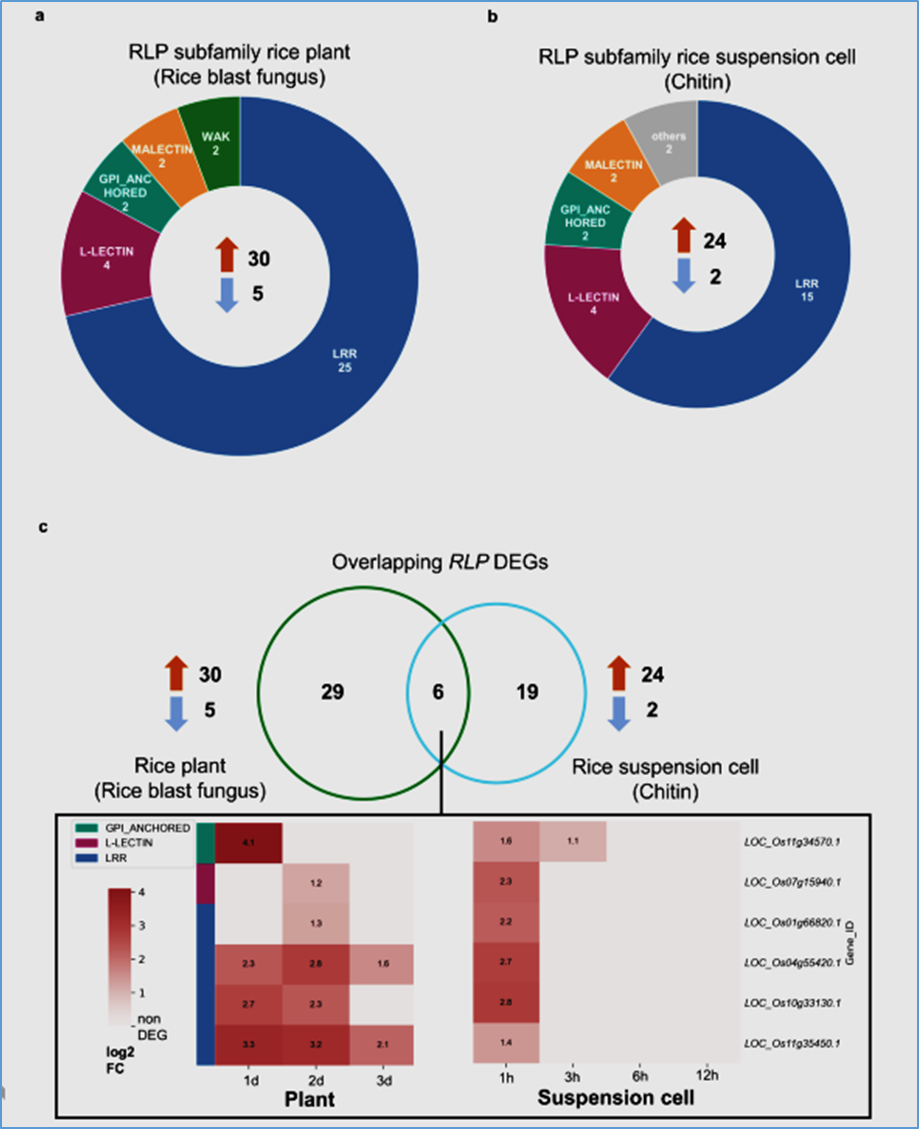
Figure 3. OsRLP DEG distribution by subfamily and gene expression profiles of overlapping DEGs in the rice plant and suspension cell experiments. OsRLP DEG subfamilies in the rice plant (a) and suspension cell (b) experiments. (c) Overlapping OsRLP DEGs and heatmap showing gene expression in log2 fold change. Red arrows indicate upregulated DEGs; blue arrows indicate downregulated DEGs.
Views: 124