


Os79, a UDP‐Glycosyltransferase, negatively regulates cadmium tolerance and accumulation in rice
Rui Guo, Hao Yu Wang, Chong Wei Zhong, Rong Rong Ma, Jiu Huang, Jin Chen, Xian Jiao Guan, Lu Zheng, Ren Fang Shen, Ming Qing Liu, Xiao Fang Zhu
Journal of Hazardous Materials; Volume 513, 15 July 2026, 142376
Abstract
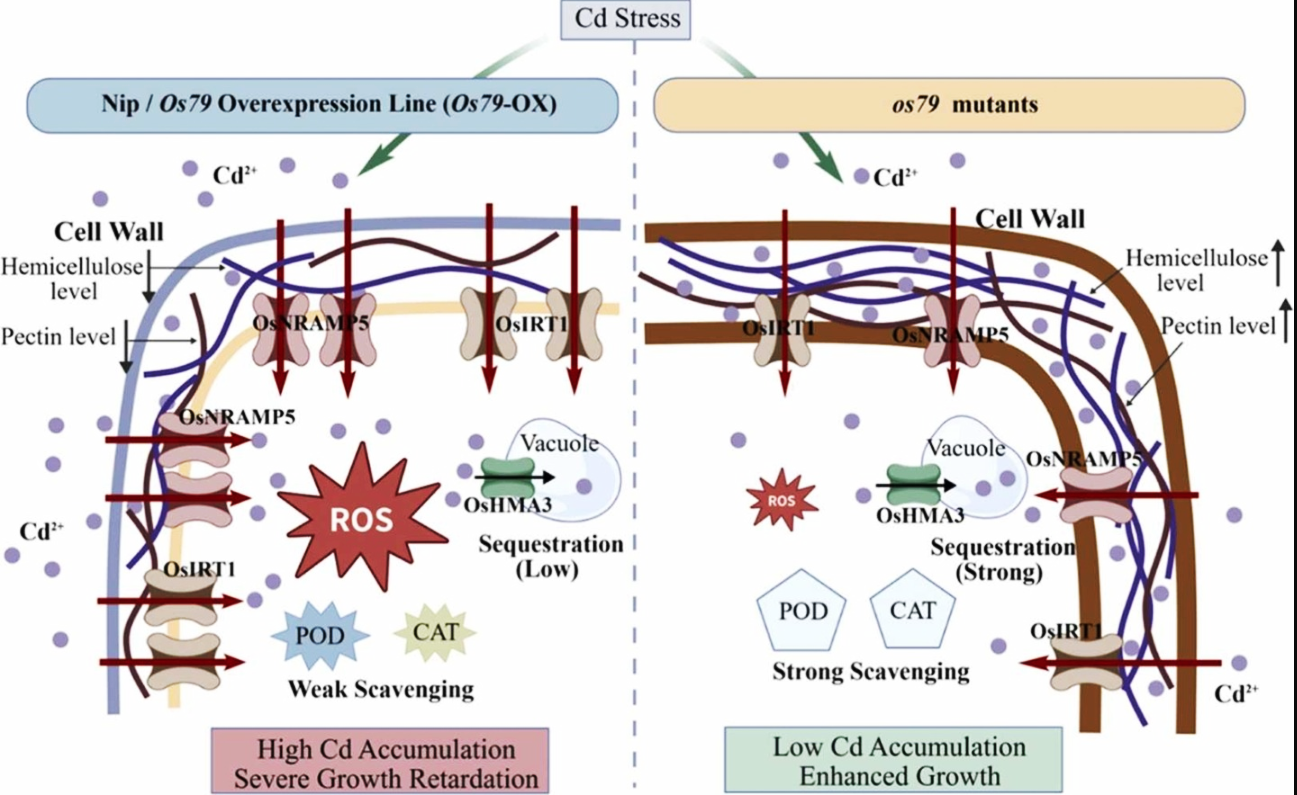
Cadmium (Cd) contamination in agricultural soils poses a significant threat to global food safety. Reducing grain Cd accumulation in rice, a primary dietary source of this toxic metal, is therefore an urgent priority. This study identified and characterized a novel UDP-glycosyltransferase gene, Os79 (LOC_Os04g12970), which functions as a key negative regulator of Cd tolerance and accumulation in rice. Using loss-of-function mutants (os79) generated by clustered regularly interspaced short palindromic repeats-CRISPR associated protein 9 (CRISPR-Cas9) and gain-of-function lines (Os79-OX), we demonstrate that a bidirectional genetic response governs Cd homeostasis: the loss of Os79 function enhances plant growth under Cd stress and significantly reduces Cd accumulation, whereas its overexpression exacerbates Cd sensitivity and accumulation. Subcellular localization analysis revealed that Os79 is localized to both the nucleus and cytoplasm. Its expression is rapidly induced at both transcriptional and protein levels upon Cd exposure. Mechanistically, the os79 mutants achieve reduced Cd toxicity through a tripartite coordinated response: (1) Transcriptional reprogramming of Cd transporters, where key uptake genes including Oryza sativa Iron-Regulated Transporter 1 (OsIRT1) and Oryza sativa Natural Resistance-Associated Macrophage Protein 5 (OsNRAMP5) are downregulated, whereas the vacuolar sequestration genes such as Oryza sativa Heavy Metal ATPase 3 (OsHMA3) are upregulated; (2) Enhanced cell-wall binding capacity, characterized by increased content of pectin and hemicellulose in root and shoot cell walls and their elevated Cd-binding ability; (3) Strengthened antioxidant defense, marked by elevated activities of peroxidase (POD) and catalase (CAT), which reduce hydrogen peroxide (H₂O₂) and malondialdehyde (MDA) levels and alleviate oxidative damage. Collectively, our findings reveal that Os79 negatively regulates an integrated detoxification network. Targeting Os79 presents a promising genetic strategy for developing low-Cd-accumulating rice varieties, contributing to safer food production in Cd-contaminated regions.
See https://www.sciencedirect.com/science/article/abs/pii/S0304389426013543
Views: 117