


Sparse testcrossing for early-stage genomic prediction of general combining ability to increase genetic gain in maize hybrid breeding programs
David O. González-Diéguez, Gary N. Atlin, Yoseph Beyene, Dagne Wegary, Dorcus C. Gemenet & Christian R. Werner
Theoretical and Applied Genetics; February 24 2026; vol. 139; article 78
 Key message
Sparse testcrossing with 3-5 testers enhances genetic gain in hybrid breeding programs, offering a practical balance of simple testcross designs, resource efficiency, and increased prediction accuracy for general combining ability.
Abstract
Sparse testcrossing is an effective strategy for increasing both short- and long-term genetic gain in hybrid breeding programs. Maize hybrid breeding programs aim to develop new hybrid varieties by crossing genetically distinct parents from different heterotic pools, exploiting heterosis for improved performance. The programs typically consist of two main components: population improvement and product development. The population improvement component aims to enhance the heterotic pools through reciprocal recurrent selection based on general combining ability (GCA). However, especially in the early stages of testing, evaluating large numbers of hybrid combinations to estimate GCA is impractical due to considerable logistical challenges and costs. Therefore, breeders often evaluate the initial population of selection candidates using only a single tester to narrow down the candidate pool before further evaluation. Using a single tester, however, may not adequately represent the heterotic pool, leading to inaccurate GCA estimates and suboptimal selection decisions. To address this, we propose sparse testcrossing for early-stage testing, where subsets of candidate genotypes are testcrossed with different testers, connected through a genomic relationship matrix. We conducted stochastic simulations to compare various sparse testcrossing designs with a conventional testcross strategy using a single tester over 15 cycles of reciprocal recurrent genomic selection. Our results show that using 3–5 testers, sparsely distributed among full-sibs, sparse testcrossing offers breeders a practical balance between simple testcross designs, resource efficiency, and increased prediction accuracy for GCA, ultimately resulting in increased rates of genetic gain.
See https://link.springer.com/article/10.1007/s00122-026-05169-x
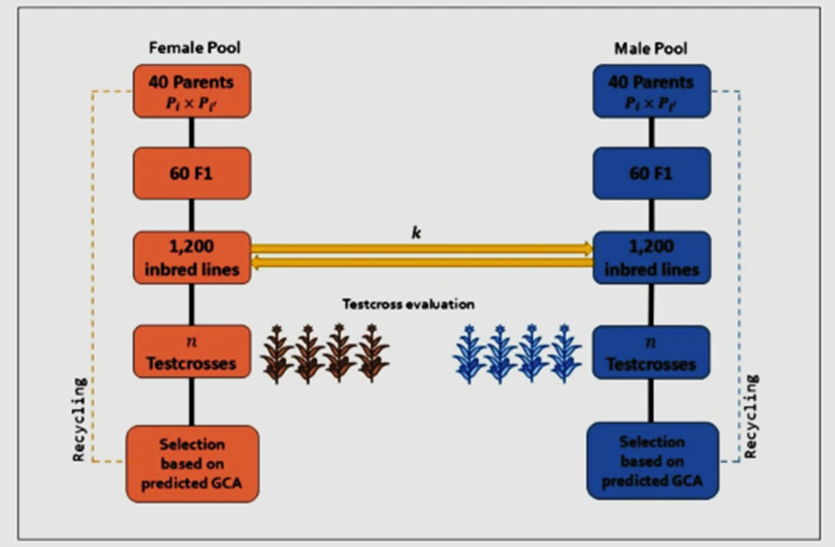
Figure 2
Schematic representation of the simulated hybrid breeding scheme, where denotes the number of testcrosses, and the number of testers. This scheme was used both as the baseline breeding program for comparing GCA prediction accuracy among testcrossing designs and as the template for running separate programs for each testcrossing strategy to assess hybrid genetic gain
Views: 142