


Semiochemicals and odorant receptors underlying potato cultivar susceptibility and resistance to potato tuber moth
Ruipeng Chen, Wangtao Hu, Qin Hu, Junjie Yan, Jiao Yin, Fathiya M. Khamis, Yulin Gao, and Walter S. Lea
PNAS; April 6 2026; 123 (15) e2537754123; https://doi.org/10.1073/pnas.2537754123
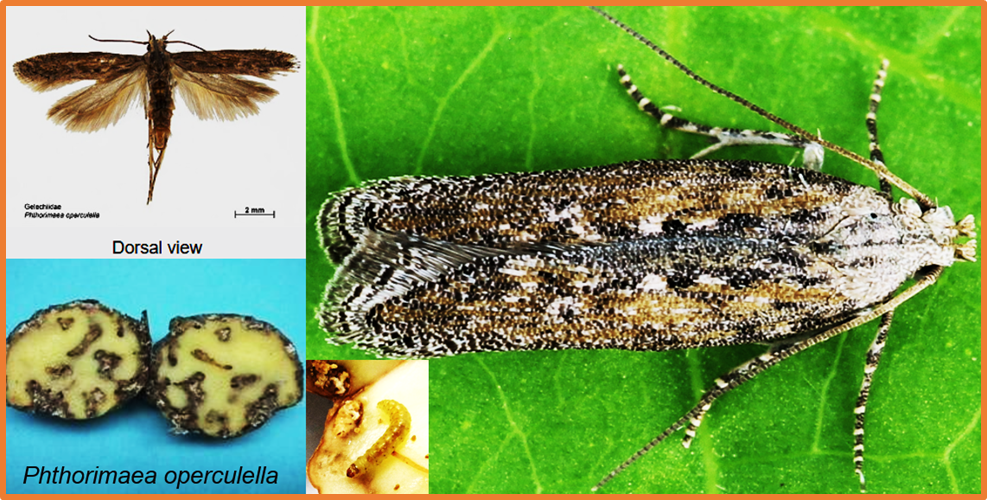
Significance
Insect pests cause substantial losses in global food production, and their control often relies on chemical insecticides with environmental costs. Environmentally friendly alternatives, such as push–pull strategies that exploit plant-derived attractants and repellents, offer promising solutions but require a mechanistic understanding of insect–plant interactions. Here, we investigate the chemical ecology of the potato tuber moth, a major worldwide pest of potato. Through integrated field surveys, laboratory assays, and molecular analyses, we identify cultivar-emitted attractants and repellents and the olfactory receptors in gravid females that mediate host selection. These findings provide a foundation for cultivar-based and semiochemical-driven strategies to sustainably manage potato tuber moth populations.
Abstract
Infestation of potato by the potato tuber moth (Phthorimaea operculella) varies markedly among cultivars, yet the chemical and molecular mechanisms underlying this variation remain poorly understood. Here, we combine field surveys, chemical ecology, functional genomics, and structural modeling to reveal how cultivar-specific volatile profiles shape moth oviposition behavior and pest outcomes. Field and laboratory assays identified marked differences in adult attraction, oviposition, and larval damage among potato cultivars, which correlated with distinct blends of emitted volatile organic compounds (VOCs). Behavioral analyses revealed that among other VOCs, trans-nerolidol and β-ionone act as attractants, whereas 3-carene and benzyl tiglate function as oviposition deterrents. Electrophysiological screening and heterologous expression deorphanized six female-biased odorant receptors (ORs), identifying three narrowly tuned receptors linked to cultivar susceptibility or resistance. PopeOR01, upregulated following mating, selectively detects the attractant trans-nerolidol, which is enriched in susceptible cultivars, whereas PopeOR15 and PopeOR73 are tuned to repellents benzyl tiglate and 3-carene, respectively, which are enriched in resistant cultivars. CRISPR/Cas9-mediated knockouts confirmed that PopeOR01 and PopeOR73 are essential for antennal detection and behavioral responses to their cognate ligands. AlphaFold3 modeling, molecular docking, and molecular dynamics simulations revealed conserved OR-Orco channel architecture and stable ligand-binding modes consistent with physiological and behavioral data. Together, our results establish a mechanistic link between potato cultivar chemistry, insect olfactory receptor function, and pest behavior, providing a molecular framework for sustainable, semiochemical-based management of the potato tuber moth.
See: https://www.pnas.org/doi/10.1073/pnas.2537754123
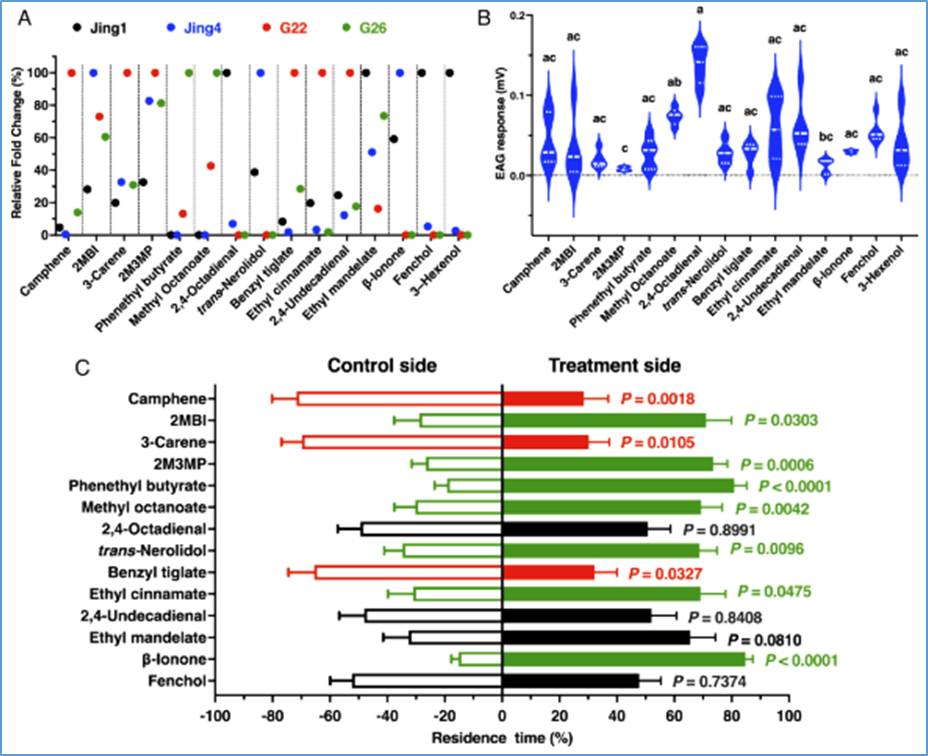
 Figure 2; Cultivar-specific volatile profiles and olfactory responses of P. operculella to candidate VOCs. (A) Relative fold change of 15 odorants in susceptible and resistant cultivars. For brevity, 2-methylbutyl isovalerate and 2-methyl-3-methylpyrazine are abbreviated in this figure as 2MBI and 2M3MP, respectively. (B) EAG responses (mean ± SE) of female antennae to the 15 VOCs. Different letters above plots indicate significant differences among cultivars (Friedman test with Dunn’s multiple-comparisons post hoc test; F = 43.54). (C) Behavioral responses of gravid females to 14 cultivar-associated VOCs in a four-arm olfactometer. Bars show the residence time (mean ± SEM, N = 20 to 25) in the odor-treated arm (solid bars) versus a paraffin-oil control (empty bars).
Views: 121