


Next-Generation Precision Breeding in Peanut (Arachis hypogaea L.) for Disease and Pest Resistance: From Multi-Omics to AI-Driven Innovations
Xue Pei, Jinhui Xie, Chunhao Liang, Aleksandra O Utkina
Insects; 2026 Jan 4; 17(1):63. doi: 10.3390/insects17010063.
Abstract
Peanut (Arachis hypogaea L.) is a globally important oilseed and food legume, yet its productivity is persistently constrained by devastating diseases and insect pests that thrive under changing climates. This review aims to provide a comprehensive synthesis of advances in precision breeding and molecular approaches for enhancing disease and pest resistance in peanut. Traditional control measures ranging from crop rotation and cultural practices to chemical protection have delivered only partial and often unsustainable relief. The narrow genetic base of cultivated peanut and its complex allotetraploid genome further hinder the introgression of durable resistance. Recent advances in precision breeding are redefining the possibilities for resilient peanut improvement. Multi-omics platforms genomics, transcriptomics, proteomics, and metabolomics have accelerated the identification of resistance loci, effector-triggered immune components, and molecular cross-talk between pathogen, pest, and host responses. Genome editing tools such as CRISPR-Cas systems now enable the precise modification of susceptibility genes and defense regulators, overcoming barriers of conventional breeding. Integration of these molecular innovations with phenomics, machine learning, and remote sensing has transformed resistance screening from manual assessment to real-time, data-driven prediction. Such AI-assisted breeding pipelines promise enhanced selection accuracy and faster deployment of multi-stress-tolerant cultivars. This review outlines current progress, technological frontiers, and persisting gaps in leveraging precision breeding for disease and pest resistance in peanut, outlining a roadmap toward climate-resilient, sustainable production systems.
See https://pubmed.ncbi.nlm.nih.gov/41598917/
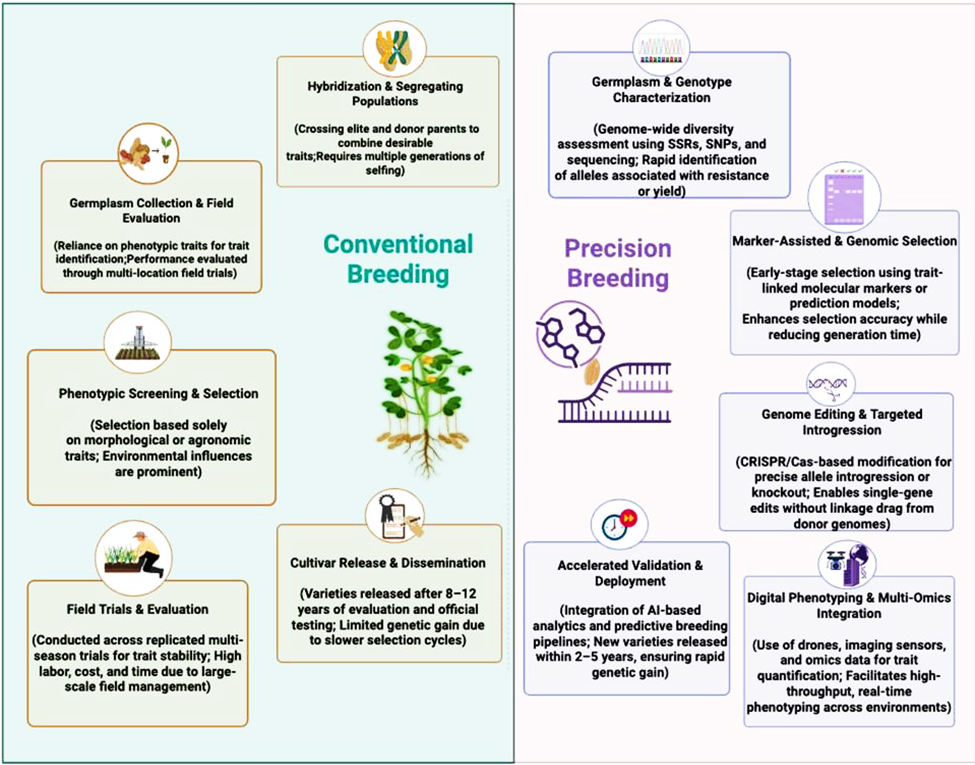
Figure 2: Comparative overview of conventional and precision breeding approaches in peanut (Arachis hypogaea L.) improvement. The left panel illustrates the traditional breeding pipeline, encompassing phenotypic selection, hybridization, and multi-season field evaluations, which are time-consuming and influenced by environmental variability. The right panel depicts the precision breeding framework integrating marker-assisted selection, genomic selection, genome editing, and digital phenotyping, enabling faster and more accurate development of pest- and disease-resistant cultivars. This visual comparison highlights how modern breeding technologies accelerate genetic gain and streamline resistance development in peanut.
Views: 175