


MeNADP-ME3 Confers Salt and Drought Tolerance in Arabidopsis and Drives Functional Diversification of the NADP-ME Family in Cassava
Shuwen Wu, Zhanming Xia, Jiazheng Zhao, Changyi Wang, Yi Min, Dayong Wang
Curr Issues Mol Biol.; 2026 Mar 20; 48(3):331. doi: 10.3390/cimb48030331.
Abstract
As a typical C3-C4 intermediate plant, cassava (Manihot esculenta Crantz) exhibits high photosynthetic efficiency and low photorespiration. NADP-malic enzyme (NADP-ME) is a key enzyme in the C4 photosynthetic pathway that provides elevated CO2 concentrations for Rubisco. However, research on NADP-ME in C3-C4 intermediate species remains limited. In this study, we identified four NADP-ME genes in the cassava genome, with segmental duplication serving as the primary driving force for gene evolution. Cis-acting element analysis indicated potential roles of MeNADP-ME genes in environmental adaptation, stress responses, and growth regulation. Expression profiling using bulk RNA sequencing and single-cell RNA sequencing revealed distinct expression patterns in different tissues and cell subsets. Comparative analysis with Arabidopsis (Arabidopsis thaliana) and maize (Zea mays) NADP-ME families demonstrated that MeNADP-ME3 exhibits bundle sheath cell-specific expression analogous to ZmchlC4NADP-ME in maize. Notably, photosynthetic genes and plasmodesmata (PD)-related genes exhibited high co-expression within mesophyll subcluster 13 and bundle sheath cells, providing molecular evidence for a limited C4 photosynthetic pathway in cassava. Protein-protein interaction predictions implicated MeNADP-ME3 in photosynthetic carbon metabolism and photorespiration regulation. Furthermore, qRT-PCR revealed significant responsiveness of MeNADP-ME3 to various abiotic stresses, and confocal imaging confirmed its chloroplast localization. Functional validation demonstrated that Arabidopsis overexpressing MeNADP-ME3 exhibited 30-120% enhanced antioxidant enzyme activities (SOD, POD, CAT) and 20-32% reduced oxidative damage markers (MDA, H2O2) under drought and salt stresses. These findings reveal the evolutionary trajectory of NADP-ME genes in C3-C4 intermediate species and provide genetic resources for developing stress-tolerant cassava cultivars.
See https://pubmed.ncbi.nlm.nih.gov/41899482/
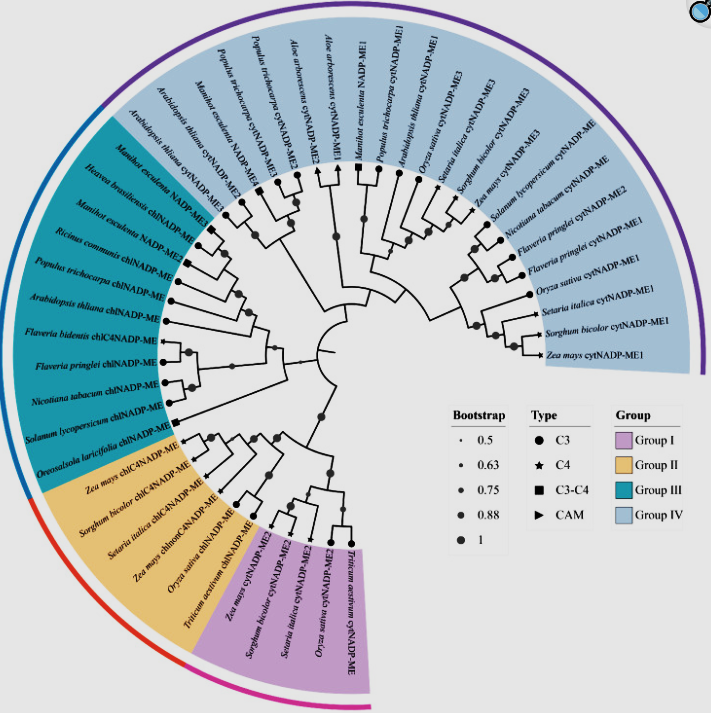
Figure 1:
Phylogenetic trees of the NADP-ME family of plants of different photosynthetic types. Different colors represent various groups: Group I (cytosolic monocot types), Group II (plastidic monocot types), Group III (cytosolic eudicot types), and Group IV (cytosolic types shared by monocots and eudicots). Bootstrap values less than 0.5 were concealed.
Views: 107