


Population genetics and phylogenomic insights into the origin of economically important black pepper (Piper nigrum)
Dominik Metschina, Luiz A Cauz-Santos, Maarten J M Christenhusz, Nilni A Wimalarathna, Tara D Silva, Andreas Berger, James W Byng, Harsha Dissanayake, Deepthi Yakandawala, Anushka M Wickramasuriya, Barbara Turner, Mark W Chase, Rosabelle Samuel
Am J Bot.; 2026 Apr 9: e70187. doi: 10.1002/ajb2.70187. Online ahead of print.
Abstract
Premise: We conducted population genetic and phylogenomic analyses of several cultivated Piper nigrum varieties and closely related species. We sought to establish (1) the genetic constitution of P. nigrum and its putative status as an allotetraploid hybrid of Indian origin, and (2) its relationships to other species of Piper in South and Southeast Asia.
Methods: We analyzed high-quality data comprising single nucleotide polymorphisms (SNPs) using RAxML, a phylogenetic network approach, and coancestry analyses to examine phylogenetic relationships. We included two putative parental species of the hypothesized allotetraploid P. nigrum (P. galeatum and P. trichyostachyon) and a set of Sri Lankan endemic species. We also determined genome sizes of several species.
Results: A clade comprising Sri Lankan endemics is more closely related to cultivated P. nigrum than the two Indian species. Most cultivated varieties of P. nigrum are autotetraploids that can be distinguished genetically, but among them are some diploid accessions.
Conclusions: Piper nigrum is a member of a clade of Sri Lankan endemics and did not originate via hybridization between the previously suggested parental species, P. galeatum and P. trichostachyon. Autotetraploid varieties of Piper nigrum are predominant in cultivation, probably due to their increased vigor and higher yields, although diploid varieties are also present, demonstrating that genome duplication probably occurred recently in cultivation.
See https://pubmed.ncbi.nlm.nih.gov/41958005/
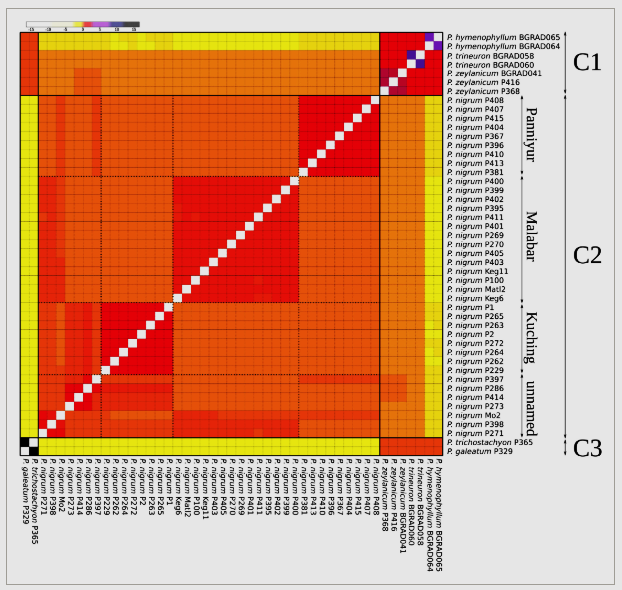
Figure 1: Heatmap of pairwise relatedness based on 50,000 SNPs. Legend (top right): relatedness coefficients as estimated by Ritland's method-of-moments estimator.
Views: 122