


Integrated physiological, biochemical and hormonal traits determine drought tolerance and yield stability in cashew (Anacardium occidentale L.)
Babli Mog, S G Harsha, Laxmi Sharma, J Dinakara Adiga, Krishnappa Rangappa, Shamsudheen Mangalassery, S V Ramesh, Manjesh Guligenahalli Narayanappa, G S Mohana, Veena Gonibeedu Lakshmana, H P Bhagya, Prabha Moirangthem, E Eradasappa, Suman Roy, C Anilkumar, A N Lokesha, B Chowdhury
Sci Rep.; 2026 Feb 22; 16(1):10179. doi: 10.1038/s41598-026-39321-w.
Abstract
Drought stress, intensified by climate change, represents a major limiting factor to growth, reproductive development, and nut productivity of cashew (Anacardium occidentale L.), especially in rainfed and marginal production systems. Identifying drought-tolerant cultivars and understanding their adaptive mechanisms are therefore critical for sustaining cashew productivity in water-limited environments. In this study, seventeen cashew varieties were evaluated under drought stress to identify tolerant genotypes and elucidate the physiological, biochemical, metabolic, and hormonal mechanisms underlying drought adaptation. A multi-trait genotype ideotype distance index (MGIDI) was employed to integrate diverse traits for robust genotype ranking and holistic drought tolerance assessment. The analysis identified ‘Priyanka’ and ‘Bhaskara’ as drought-tolerant varieties, whereas ‘Ullal-2’, ‘Vengurla-2’, and ‘Madakkathara-1’ were classified as drought-sensitive. Drought stress resulted in a significant reduction in nut yield (63.2%), accompanied by impaired nutrient uptake, reduced chlorophyll content (59.7%), and compromised membrane integrity, with more pronounced effects in sensitive varieties. In contrast, tolerant varieties showed increased antioxidant enzyme activities, including ascorbate peroxidase and polyphenol oxidase, along with increased accumulation of stress-responsive metabolites such as proline and soluble sugars, which contributed to improved oxidative stress mitigation and osmotic adjustment. Drought tolerance was further linked to differential accumulation of phenolic acids and flavonoids as well as higher endogenous levels of abscisic acid, jasmonic acid, and indole-3-acetic acid, all of which were positively correlated with nut yield under drought conditions. This integrated MGIDI-based assessment links coordinated physiological, metabolic, and phytohormonal responses to drought tolerance in cashew, offering robust selection criteria for breeding and deploying climate-resilient cultivars in drought-prone areas.
See: https://pubmed.ncbi.nlm.nih.gov/41724738/
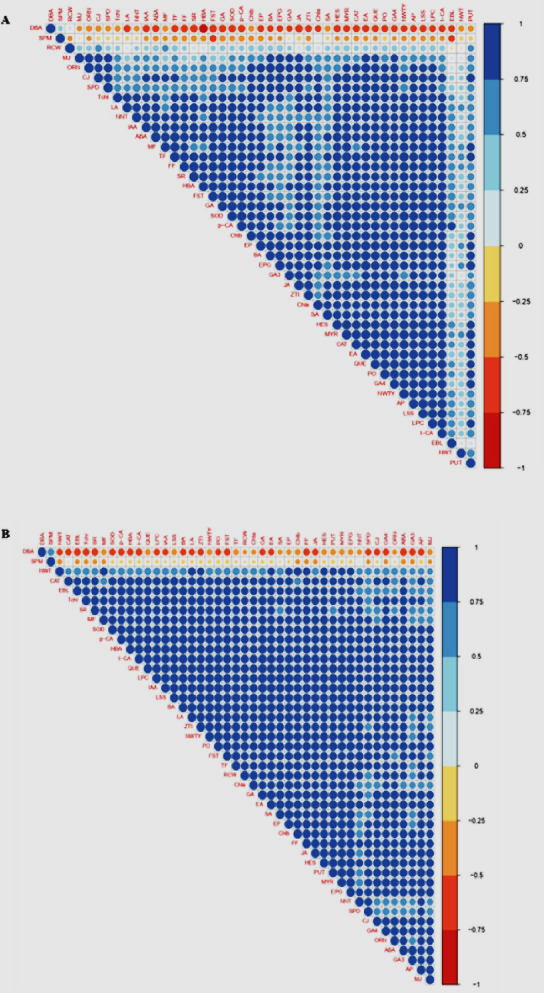
Figure 7: Correlation matrix of physiological traits, biochemical parameters, yield and yield components, hormone profile, phenolic profile, flavonoid profile and polyamine profile of seventeen cashew varieties evaluated under (A ) control and (B) drought stress conditions. DBA: 2,4-dihydroxybenzoic acid, SPM: Spermine, NWT: Nut weight, CAT: Catechin, EBL: Epibrasinolide, Tchl: Total chlorophyll, SR: Sex ratio, MF: Male flower, SOD: Super oxide dismutase, p-CA: p-Coumaric acid, HBA: 3-Hydroxy benzoic acid, t-CA: t-Cinnamic acid, QUE: Quercetin, LPC: Leaf proline content, IAA: 3-Indole Acetic Acid, LSS: Leaf soluble sugar, BA: Benzoic acid, LA: Leaf area, ZTI: Zeatin trans isomer, NWTY: Nut yield, PO: Polyphenol Oxidase, FST: Fruit set, TF: Total flower, RCW: Relative water content, Chl a: Chlorophyll a, GA: Gallic acid, EA: Ellagic acid, SA: Salicylic Acid, EP: Epicatechin, Chl b: Chlorophyll b, FF: Female flower, JA: Jasmonic Acid, HES: Hesperetin, PUT: Putrescine, MYR: Myricetin, EPG: Epigallocatechin, NNT: Nut number, SPD: Spermidine, CJ: Cis-Jasmone, GA4: Gibberellic Acid 4, ORN: Ornithine, ABA: Abscisic Acid, GA3: Gibberellic Acid 3, AP: Ascorbate Peroxidase, MJ: Methyl Jasmonate. The direction of correlation coefficients is indicated with a gradient colour scale on the right side of the figure. Positive correlations are marked with blue colour and negative correlations in red colour; the intensity of colour indicates the strength of correlations. The variables negatively correlated are clustered in the top rows for better visualization.
Views: 141