


Role of Altered Metabolites and Metabolic Pathways in Major Tuber Crops Under Drought Stress
Maltase Mutanda, Fikile N Makhubu, Sandiswa Figlan
Plant Environ Interact.; 2026 Feb 13;7(1): e70126. doi: 10.1002/pei3.70126.
Abstract
Drought stress poses a significant challenge to growth and productivity of major tuber crops, particularly cassava (Manihot esculenta Crantz), potato (Solanum tuberosum L.) and sweet potato (Ipomoea batatas (L.) Lam.). These crops are among the most widely cultivated tubers globally and play a critical role in food and nutritional security, especially in drought-prone regions of sub-Saharan Africa, Asia and Latin America. Several studies have highlighted that metabolites such as sucrose, proline and arginine contribute to osmotic adjustment, cellular protection and energy balance under drought stressed conditions. However, a comprehensive synthesis of drought-induced metabolic responses and associated pathways utilized by major tuber crops remains limited. Therefore, this study aimed to identify and evaluate the metabolic responses and pathways altered under drought stress in major tuber crops (cassava, potato and sweet potato). A cross-study analysis of peer-reviewed research articles retrieved from Web of Science and Scopus databases identified 223 metabolites reported to be significantly altered under drought-stressed compared with non-stressed conditions across 30 original research articles published between 2010 and 2024. MetaboAnalyst platform was used to map metabolites to their respective pathways and to quantify pathway enrichment. The higher number of drought-responsive metabolites was reported in potato, followed by sweet potato, reflecting the greater availability of metabolomics studies for these crops, whereas the limited metabolite information for cassava is attributable to fewer published studies rather than reduced drought responsiveness. Trehalose and proline were found to be the most commonly studied and highly affected metabolites across the three crops. Enriched metabolic pathways included glyoxylate and dicarboxylate metabolism, the citrate cycle, alanine, aspartate and glutamate metabolism, galactose metabolism, and starch and sucrose metabolism. The present findings clearly call for further research to expand metabolomics investigations, particularly in cassava which is widely promoted for its climate resilience across sub-Saharan Africa, to unravel regulatory mechanisms linking metabolites, gene expression and drought-adaptive phenotypes. Therefore, an integration of metabolomics with transcriptomics and proteomics could also provide a more comprehensive overview of the tuber crops' responses to drought stress, helping in accelerating breeding efforts while ensuring improved food security.
See https://pubmed.ncbi.nlm.nih.gov/41694540/
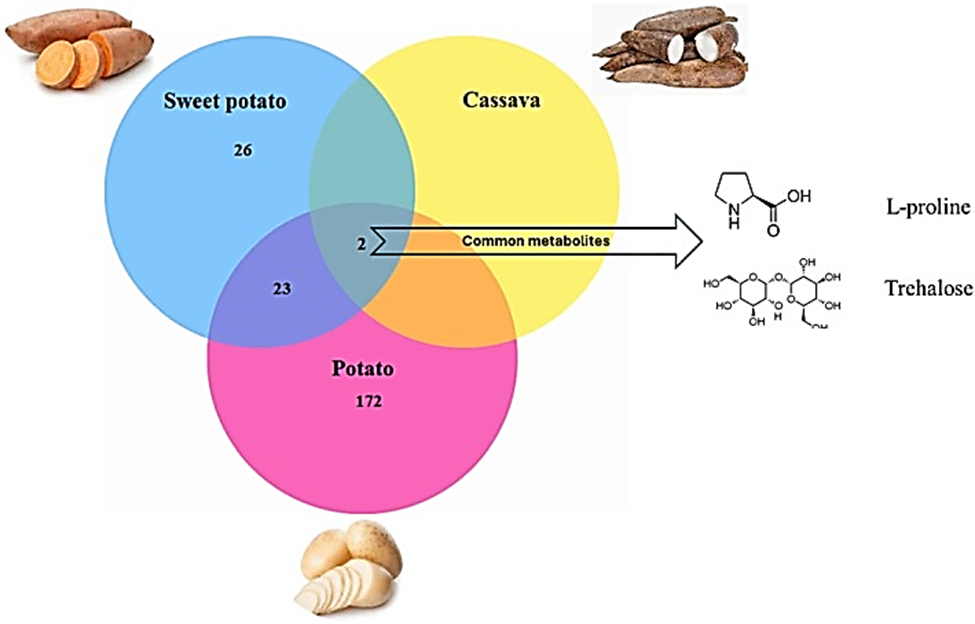
Figure 2
Venn diagram showing the significantly affected metabolites in three major tuber crops (sweet potato, cassava and potato) under drought‐stressed conditions. The numbers within each section represent the count of unique or shared metabolites among the three crops. Sweet potato exhibits 26 unique metabolites, cassava has no unique metabolite, and potato contains 172 distinct metabolites. Twenty‐three metabolites are shared between sweet potato and potato, while only two metabolites are common across all three crops. The common metabolites, depicted with their chemical structures, include proline and trehalose based on screened studies.
Views: 101