


Regulation of grain protein content by the amino acid permease gene OsAAP4 in rice
Ming-Xin Li, Feng-Lin Huang, Jin-Hong Lin, Jia-Yi Qu, Guo-Feng Wan, Gen-Cai Song, Jing Zhao, Yan Peng, Zhen-Ning Teng, Ling Liu, Cheng Zheng, Hou-Xiong Wu, Ding-Yang Yuan, Mei-Juan Duan, Neng-Hui Ye & Shuan Meng
Theoretical and Applied Genetics; January 28 2026; vol. 139; article 50
Abstract
Rice grain protein content is crucial for its quality and nutritional value, but the mechanisms of nitrogen transport to the grain remain poorly understood. This study demonstrates that the amino acid transporter OsAAP4 regulates protein accumulation in rice grains. OsAAP4 is expressed during grain filling, increasing at the mid-filling stage. Analysis of aap4 mutants in Zhonghua11 and Nipponbare backgrounds revealed significantly reduced grain yield and polished rice protein content compared to wild-type. Furthermore, mutant grains showed markedly lower nitrogen content at both filling and maturity stages. Analysis of amino acid concentrations revealed that the contents of most amino acids in the grains of the aap4 mutant were significantly lower than those in the wild type. Nitrogen content analysis indicated that the aap4 mutation had a minimal impact on plant nitrogen content, suggesting that the reduced grain protein content in the aap4 mutant was due to its loss of function within the grain. Yeast heterologous complementation experiments suggest that OsAAP4 may mediate the transmembrane transport of amino acids. Further investigation revealed that OsAAP4 can encode a plasma membrane localized protein and is expressed in the vascular bundles of grains during filling. Interestingly, overexpression of OsAAP4 simultaneously increased both rice yield and grain protein content. Transcriptomic analysis revealed that OsAAP4 may influence plant hormone signaling, protein formation on the ER, and various amino acid metabolic processes in grains. Collectively, these findings indicate that OsAAP4 might plays a crucial role in the translocation of amino acids into grains, thereby regulating grain protein content.
See: https://link.springer.com/article/10.1007/s00122-026-05158-0
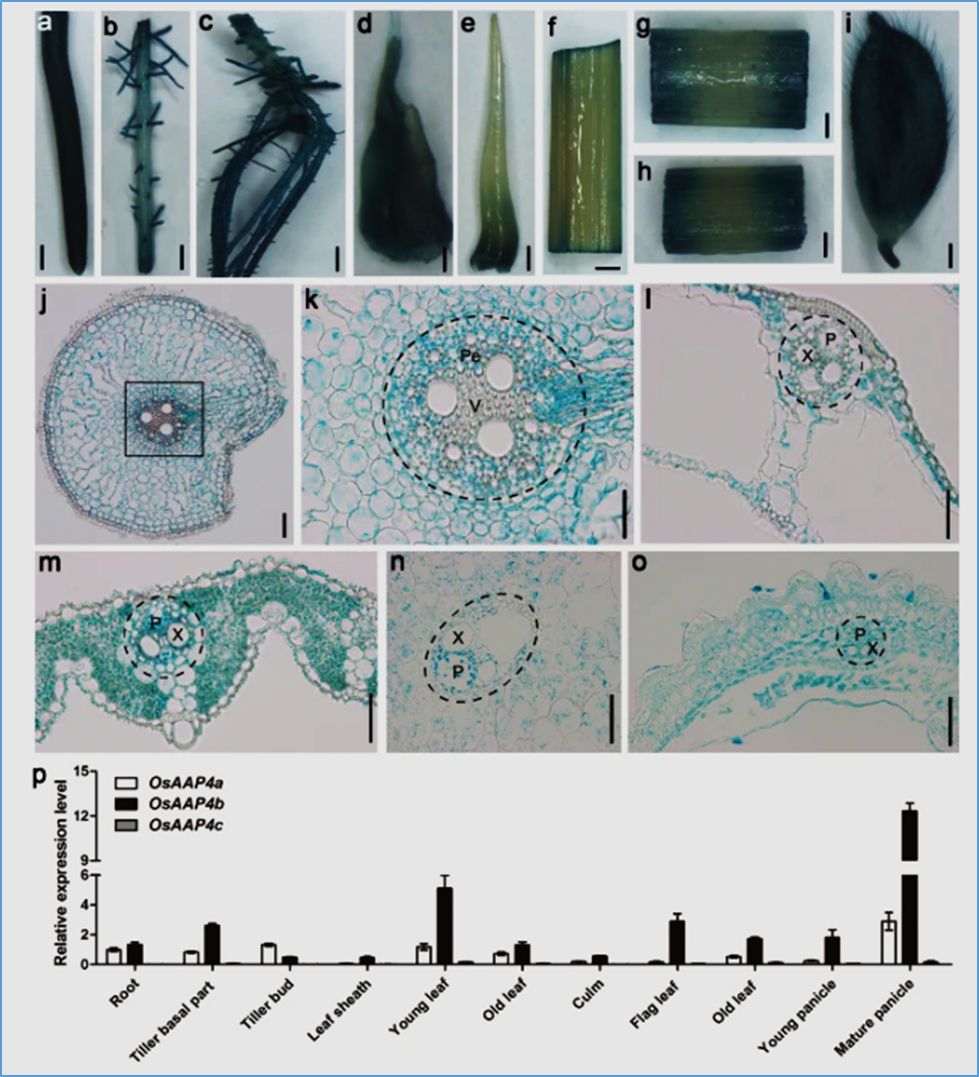
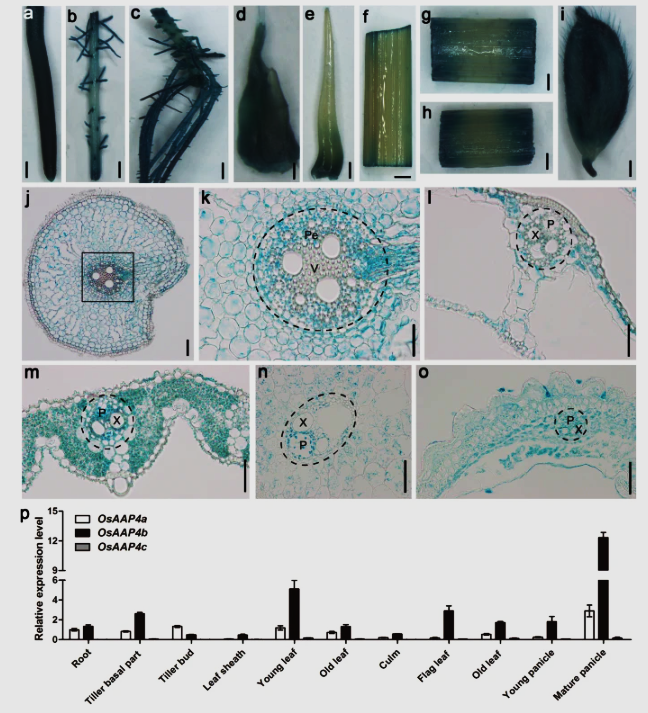 Figure:
Promoter-GUS analysis and relative expression level of OsAAP4. OsAAP4 promoter-GUS staining in the root tip (a), lateral root (b), adventitious roots (c), short outgrowth bud (d), long outgrowth bud (e), leaf blade (f), leaf sheath (g), stem (h), and panicle (i) using the Hap2-Indica type of pOsAAP4-GUS-transgenic plants. Transverse section of a root (j) and its enlargement (k), leaf sheath (l), leaf blade (m), stem (n), and panicle (o) using the Hap2-Indica type of pOsAAP4-GUS transgenic plants. p The expression pattern of OsAAP4 in different tissues of Japonica ZH11. The primers used for quantifying OsAAP4a expression was F: TGGCACTCACCCTTGCACAC, and R: CCGTCCACACCGTCCCTTGT, for quantifying OsAAP4b expression was ACTTGAGCTCTCTGCATTGGGT, and R: AGCGGTAGCAATTGGCGAGGA, and for quantifying OsAAP4b + c expression was TTGCTGCAGGTGTTCGCGCA, ATCGTCCGCAGCACCAGCTTCAG which primers were designed for common sequences between two splice variants OsAAP4b and OsAAP4c. OsAAP4c of the two splice variants accounts for half of the expression level for both the splice variants. Pe indicates pericycle, V indicates vascular, X indicates xylem, and P indicates phloem in (k-o). Scale bars, 0.5 cm (a-c, f-h), 0.2 cm (d), 0.1 cm (e, i), 50.0 μm (j), 20.0 μm (k-o) (Fang et al. 2021)
Views: 213