


Reference based transcriptome assembly of Piper nigrum L. reveals novel genes and transcripts in drought tolerance
Sona Charles, Muhammed Fayad Abdulkabeer, K S Krishnamurthy, Theertha Azhakoth Parambathu, T E Sheeja
Front Plant Sci.; 2026 Jan 21:16:1708920. doi: 10.3389/fpls.2025.1708920.
Abstract
Introduction: Black pepper (Piper nigrum L.), renowned as the "King of Spices," holds significant economic and medicinal value but is highly susceptible to drought stress, which impacts its growth and productivity. Several studies have reported the impact of drought stress on morphological, physiological and biochemical characteristics, while the molecular mechanism underlying drought tolerance remains largely unexplored.
Methods: This study focusses on the molecular basis of drought tolerance in black pepper through identification of differentially expressed genes (DEGs) by comparative transcriptome analysis involving drought-tolerant Accession (No. 4226) under control and water deficit conditions, and validation of these DEGs by co-expression analysis involving drought-tolerant (IISR Thevam and Acc. No. 4226) and drought-susceptible (Panniyur-1) genotypes under water-deficit conditions.
Results: Reference based assembly of RNAseq data and differential gene expression analysis revealed 2,780 DEGs such as RUBISCO-S, 50S_RP, SPX, associated with photosynthetic carbon assimilation, stress-induced regulation of protein synthesis and phosphate homeostasis under nutrient and drought stress, respectively. Functional annotation highlighted enriched biological processes such as metabolic reprogramming and secondary metabolite biosynthesis, while pathway analyses emphasized the role of starch and sucrose metabolism and RNA processing pathways in drought adaptation.
Discussion: Validation of key DEGs such as catalase, defensin, RUBISCO, MYB101, SGNH, GIB67 and ZAT10 through RT-qPCR confirmed the transcriptome data and the higher expression in drought tolerant accessions, indicated their involvement in imparting tolerance to drought. The findings also provided valuable insights regarding correlation of molecular and physiological mechanisms underlying drought tolerance in black pepper thereby laying the groundwork for developing high-yielding, drought-tolerant black pepper cultivars.
See https://pubmed.ncbi.nlm.nih.gov/41647647/
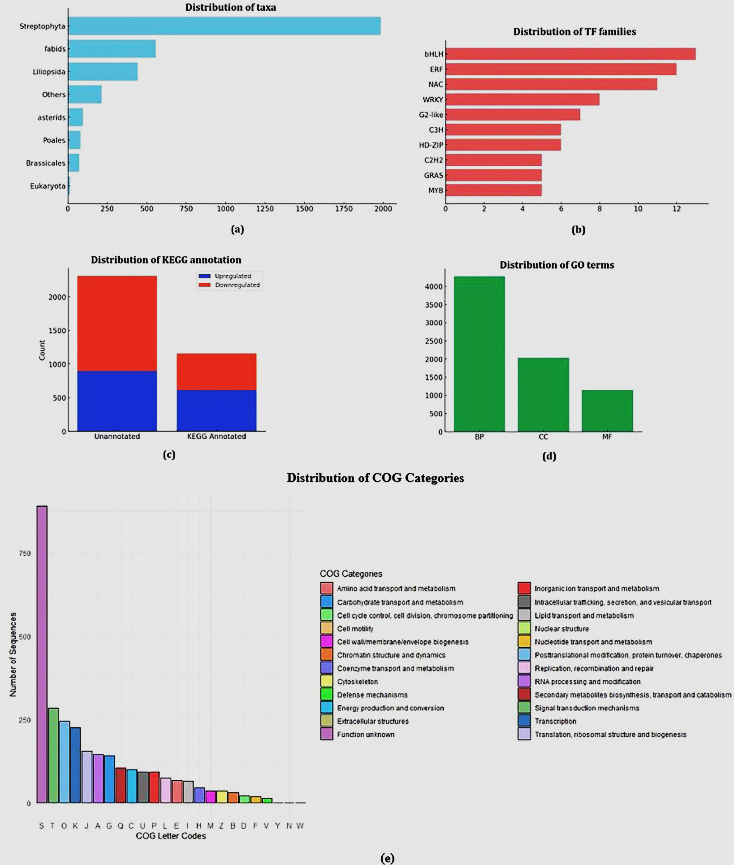
Figure 5: Distribution of various parameters in the transcriptome (a) Taxonomy of DEGs (b) Transcription Factor Families (c) KEGG annotation (d) Number of GO Terms (e) COG Categories.
Views: 114