


ProPE expands the prime editing window and enhances gene editing efficiency where prime editing is inefficient
Sarah Laura Krausz, Dorottya Anna Simon, Zsuzsa Bartos, Zsuzsanna Biczók, Éva Varga, Krisztina Huszár, Péter István Kulcsár, András Tálas, Zoltán Ligeti & Ervin Welker
Nature Catalysis (2025) Published: 10 October 2025
Abstract
Prime editing (PE) is a promising gene editing method that exploits a reverse transcriptase fused to a Cas9, whose single guide RNA (sgRNA) is extended with a reverse transcriptase template containing the desired DNA modifications. Its efficiency and specificity are inconsistent, requiring extensive optimization. To address this, we propose prime editing with prolonged editing window (proPE), which uses a second non-cleaving sgRNA to target the reverse transcriptase template near the edit site. ProPE requires less optimization than PE and extends PE’s potential for allele-specific modifications. By overcoming five limitations of PE, proPE significantly increases overall editing efficiency 6.2-fold up to 29.3% for low-performing edits (<5% with PE) and broadens its applicability to modifications beyond the typical PE range, encompassing a major portion of human pathogenic single nucleotide polymorphisms. With these enhanced properties, proPE holds considerable promise for improved gene editing, including disease modelling and therapeutic intervention.
See https://www.nature.com/articles/s41929-025-01406-6
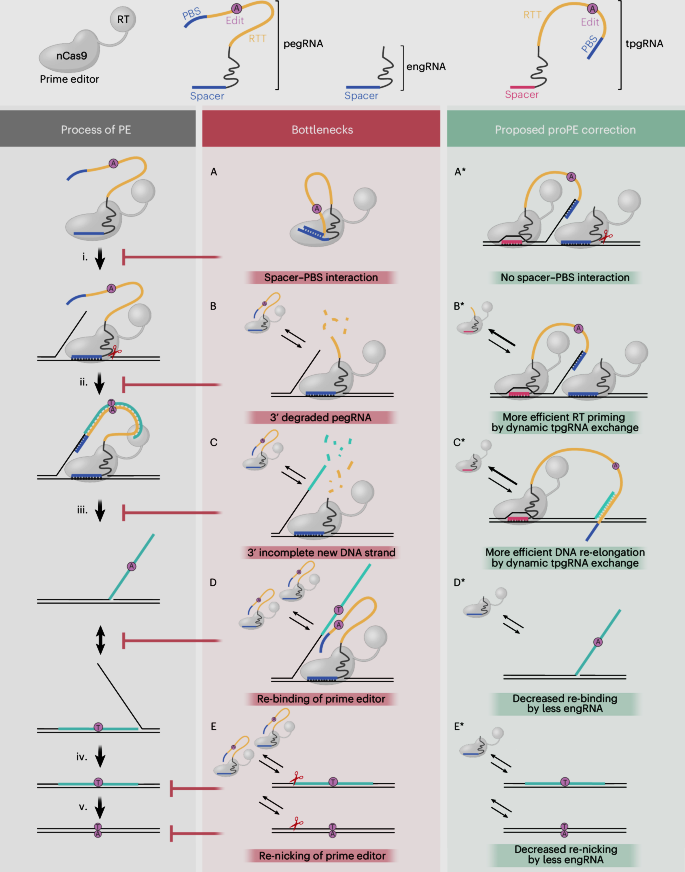
Figure 1
Schematic representation of the PE process depicting the steps (i–v), where potential bottlenecks (A–E) may inhibit PE efficiency that are eliminated by the proposed corrective mechanisms of proPE (A*–E*). nCas9, nickase Cas9.
Views: 320