


Pan-Genome Analysis and Expression Profiling of HIPP Gene Family in Cassava
Zhanming Xia, Jiazheng Zhao, Changyi Wang, Shuwen Wu, Yuwei Zang, Dayong Wang, Shousong Zhu, Yi Min
Genes (Basel); 2026 Jan 27; 17(2):136. doi: 10.3390/genes17020136.
Abstract
Background: Cassava (Manihot esculenta Crantz) ranks as the sixth largest food crop worldwide and serves as an important cash and energy crop. Heavy-metal-associated isoprenylated plant proteins (HIPPs) are metallochaperones involved in metal homeostasis and stress adaptation in vascular plants. However, research on the identification and function of HIPPs in cassava has been poorly explored.
Methods: This study conducted a pan-genome-wide investigation to identify and characterize MeHIPPs in 31 cassava accessions. Subsequent analyses examined their physicochemical properties, subcellular localization, phylogeny, Ka/Ks, chromosomal localization, synteny, gene structure, and cis-acting elements. Additionally, the expression profiles of MeHIPPs in different tissues and cell subsets and under different stress conditions were analyzed using transcriptome data and quantitative real-time polymerase chain reaction (qRT-PCR).
Results: A total of 59 MeHIPP pan-genes were identified, including five core genes, 22 softcore genes, 17 dispensable genes, and 15 private genes, which were unevenly distributed on chromosomes. Based on phylogenetic analysis, these genes were classified into five major subgroups. Evolutionary analyses indicated that segmental duplication predominated in family expansion and that most members may be subjected to purifying selection. Cis-element analysis highlighted the importance of MeHIPPs in plant adaptation to environmental stress. The expression profiles suggested widespread involvement of MeHIPP genes in response to Xanthomonas phaseoli pv. manihotis (Xpm) infection and drought stress. Different MeHIPP genes exhibited varying transcript levels in different tissues and cell subsets. qRT-PCR analysis revealed that the selected MeHIPP genes had distinct expression patterns under Cd stress.
Conclusions: This study provides valuable insights into the functional characteristics of MeHIPP genes and their evolutionary relationships, laying a theoretical foundation for further functional research on stress resistance.
See https://pubmed.ncbi.nlm.nih.gov/41751520/
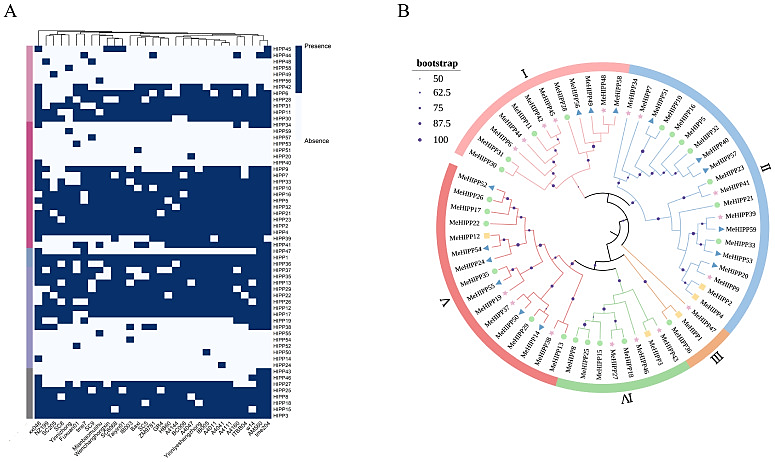
Figure 1:
Phylogenetic and presence/absence analyses of the MeHIPP gene family. (A) Heatmap showing the presence/absence variation in HIPP genes across 31 cassava genomes. Dark blue indicates the presence of genes, whereas ghost white denotes the absence of genes. (B) Phylogenetic tree of the HIPP gene family in cassava. The phylogenetic tree is divided into five major clades, designated I–V. Different colors represent the various subgroups. Squares represent core genes, circles represent softcore genes, asterisks represent dispensable genes, and triangles represent private genes.
Views: 139