


Paired NLRs originated from Triticum dicoccoides coordinately confer resistance to powdery mildew in wheat
Huaizhi Zhang, Miaomiao Li, Gaojie Wang, Keyu Zhu, Guanghao Guo, Hongkui Fu, Chenchen Hu, Zhiying Chu, Jinghuang Hu, Qiuhong Wu, Yongxing Chen, Dan Qiu, Jingzhong Xie, Delin Li, Beibei Li, Wenling Li, Lei Dong, Yikun Hou, Xuejia Cui, Baoge Huang, Yi Liu, Yiwen Li, Hongjie Li, Chengguo Yuan, Lingli Dong, Zhiyong Liu & Ping Lu
Nature Communications; 16, Article number: 9040 (2025)
Abstract
Wheat has evolved diverse resistance genes against powdery mildew, typically controlled by single-gene-encoded proteins. Here, we report the map-based cloning of PmWR183, a resistance locus encoding two adjacent NLR proteins (PmWR183-NLR1 and PmWR183-NLR2) from wild emmer wheat. Stable transformation and CRISPR/Cas9 knockout experiments demonstrate that the two NLRs function cooperatively: neither gene alone confers resistance, but their co-expression restores immunity, while disruption of either gene abolishes resistance. PmWR183 mediates a developmental stage-dependent response, with susceptibility at the seedling stage and strong resistance at the adult stage. Protein interaction assays reveal constitutive association of PmWR183-NLR1 and PmWR183-NLR2, supporting their cooperative role. Geographical and haplotype analyses show the locus originates from wild emmer and is rare in cultivated wheat, exhibiting at least nine haplotypes. Together, our findings uncover a rare NLR gene pair conferring effective resistance to powdery mildew, providing valuable resources for wheat breeding.
See https://www.nature.com/articles/s41467-025-64049-y
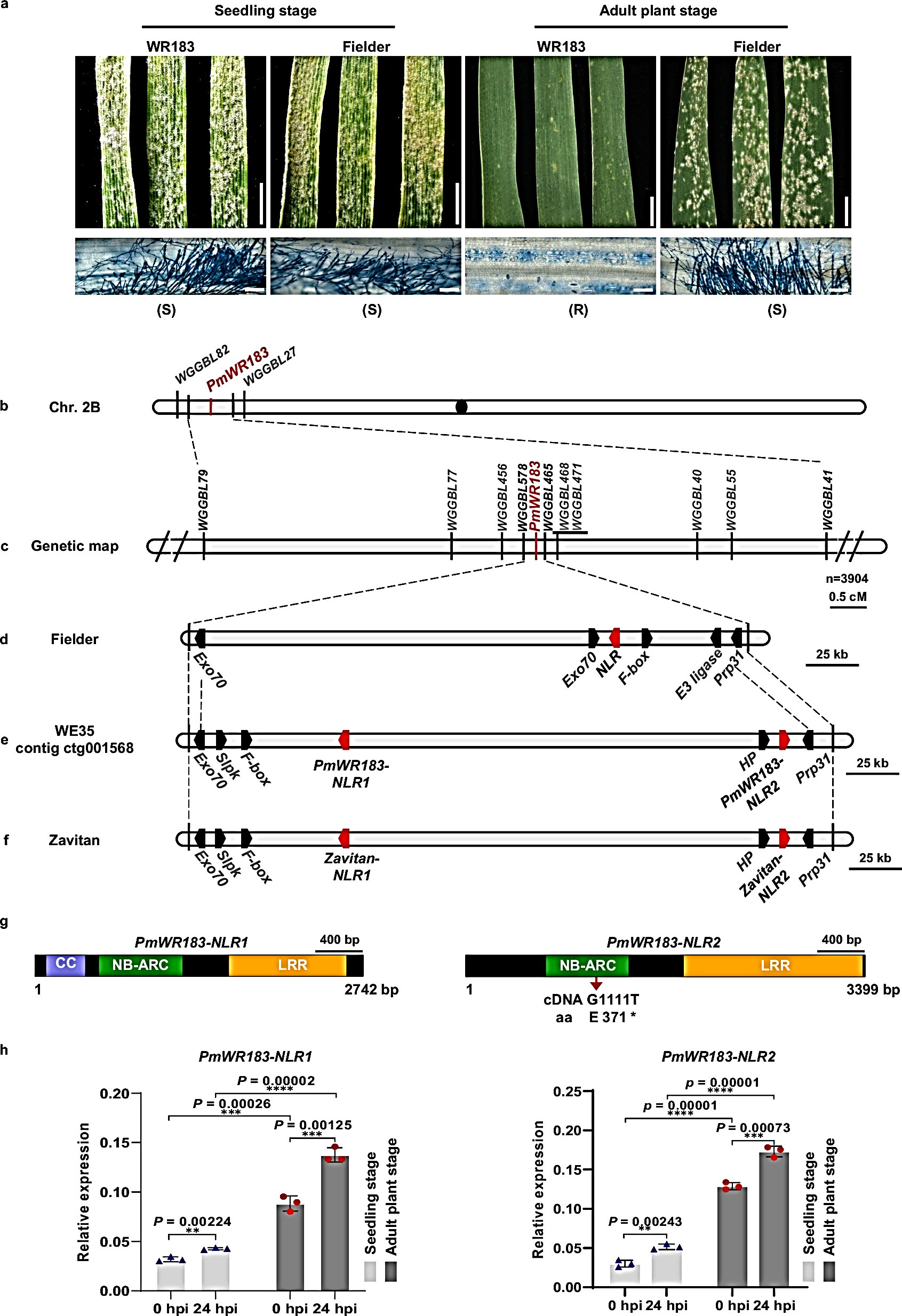
Fig. 1: Map-based cloning of PmWR183.
a Seedling and adult plant responses of parental lines WR183 and Fielder to Bgt isolate E20. Plant leaves were detached and photographed at 10 days post-inoculation (dpi) of the two-leaf (seedling) and 20 dpi of the jointing (adult) stage. Scale bar, 0.5 cm. R and S under pictures indicate the resistance and susceptibility of the plants to Bgt, respectively. Fungal structures of Bgt isolate E20 at 5 dpi (seedling stage) or 10 dpi (adult stage) were stained by Coomassie Brilliant Blue, respectively. Scale bar, 100 μm. b, c Genetic map of PmWR183 on the chromosome arm 2BS. d–f Physical map of PmWR183 locus on Fielder, contig ctg001568 of WE35, and Zavitan (WEW v1.0) reference genome, respectively. The red boxes indicate NLR genes. g Genomic structure and variations of PmWR183-NLR1 and PmWR183-NLR2 genes in WR183 and Zavitan. The nucleotide and corresponding amino acid change in PmWR183-NLR2 are shown as indicated. h The relative expression levels of PmWR183-NLR1 and PmWR183-NLR2 in WR183 at both seedling and adult plant stages under mock (uninoculated) and Bgt isolate E20 inoculation. Leaves from WR183 were collected 24 h after Bgt inoculation at both the two-leaf (seedling) and jointing (adult) stages. TaActin was used as the endogenous control. Data are means ± SEM (n = 3 biologically independent samples). Data were analyzed by two-tailed Student’s t-test (**p < 0.01, ***p < 0.001, ****p < 0.0001). Source data are provided as a Source data file.
Views: 159