


OsEHD1 and OsEHD2, two EH domain proteins targeted by E3 ubiquitin ligase OsBBI1, negatively modulate rice immunity against blast and bacterial blight diseases
Yan Bi, Yuqing Yan, Hui Wang, Leeza Tariq, Jiamu Wang, Dayong Li, Yayun Yang Fengming Song
The Crop Journal; Available online 20 September 2025
Abstract
Posttranslational modifications (PTMs) are essential regulatory mechanisms that play a critical role in plant immunity. Previously, we demonstrated that OsBBI1, a RING finger type E3 ligase, contributes to rice resistance against blast disease. In this study, we identified two Eps15 homology domain (EHD)-containing proteins, OsEHD1 and OsEHD2, as substrates of OsBBI1 and investigated their roles in rice immunity against Magnaporthe oryzae and Xanthomonas oryzae pv. oryzae (Xoo). We found that OsBBI1 ubiquitinated and promoted the degradation of OsEHD1 and OsEHD2 via ubiquitin/26S proteasome system (UPS) pathway. CRISPR/Cas9-mediated knockout of OsEHD1 and OsEHD2 led to enhanced immunity against M. oryzae and Xoo, improved expression of pathogen-induced immunity-associated genes, and strengthened pattern-triggered immunity (PTI), while overexpression of OsEHD1 resulted in opposite phenotypes. Additionally, OsEHD1 and OsEHD2 interacted with three SUMO proteins, OsSUMO3, OsSUMO5, or OsSUMO6, with SUMOylation sites in OsEHD1 and OsEHD2 being critical for these interactions. OsSUMO6 enhanced the stability of OsEHD1 and OsEHD2 to promote their negative immune regulation, whereas OsBBI1 reversed these negative immune functions. This study delineates a regulatory network of OsEHD1 and OsEHD2 proteins in rice immunity, highlighting the balance between OssBBI1-mediated ubiquitination and SUMOylation.
See https://www.sciencedirect.com/science/article/pii/S2214514125002144
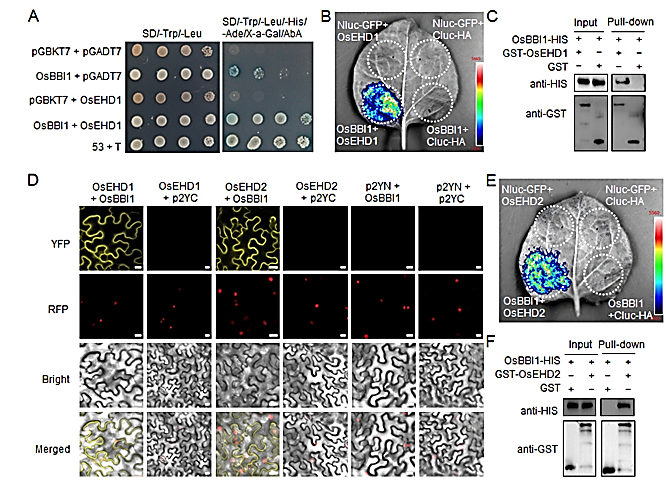
Fig. 1. OsBBI1 directly interacts with OsEHD1 and OsEHD2. (A) Interaction of OsBBI1 and OsEHD1 in yeast two-hybrid assays. Yeast strains carrying the indicated pairs of pGBKT7 and pGADT7 recombinant plasmids or empty vectors were grown on SD/-Trp/-Leu medium for 3 d and then screened on SD/-Trp/-Leu/-His/-Ade/X-a-gal/AbA medium. Protein-protein interaction was assessed based on growth performance and the appearance of blue pigment in yeast colonies. (B) Interaction of OsBBI1 and OsEHD1 in luciferase complementation imaging assays. Agrobacteria carrying the indicated NLuc and CLuc recombinant plasmids or empty vectors were co-infiltrated into Nicotiana benthamiana leaves, and fluorescent signals were visualized 48 h post agroinfiltration. (C) Interaction of OsBBI1 and OsEHD1 in glutathione S-transferase pull-down assays. GST-OsEHD1 or GST was incubated with OsBBI1-HIS and immunoprecipitated with GST resin for 3 h. The input and immunoprecipitated proteins were analyzed by immunoblotting using anti-HIS and anti-GST antibodies. (D) Interaction of OsBBI1 with OsEHD1 and OsEHD2 in bimolecular fluorescence complementation assays. Agrobacteria carrying the indicated recombinant p2YN and p2YC plasmids or empty vector were co-infiltrated into N. benthamiana leaves and fluorescent signals were visualized 48 h post agroinfiltration. Scale bars, 20 lm. (E, F) Interaction between OsBBI1 and OsEHD2 in luciferase complementation imaging (E) and glutathione Stransferase pull-down (F) assays. All experiments were independently conducted three times with similar results
Views: 173