


OsAld-Y on qATS6 links to alkalinity tolerance at the seedling stage in Oryza sativa L. ssp. Japonica
Lei Lei, Liangzi Cao, Guohua Ding, Jinsong Zhou, Yu Luo, Lei Chen, Yang Ren, Jiangxu Wang, Kai Liu, Qingjun Lei, Yusong Miao, Tingting Xie, Guang Yang, Xueyang Wang, Wei Zheng,
Front. Plant Sci., 10 March 2026 (Volume 17 - 2026 | https://doi.org/10.3389/fpls.2026.1716444)
Abstract
Salinity and alkalinity stress is one of the main factors limiting the yield of rice. The damage to growth caused by alkaline stress is more severe than the damage caused by neutral salt stress. At present, there are limited genetic resources QTLs and genes available for rice breeders to improve alkalinity tolerance. To reveal new alkaline tolerance loci, we phenotyped 1,002 F2:3 lines from Teng-Xi144 (TX144, alkalinity-sensitive)×Long-Dao19 (LD19, alkalinity-tolerant) for seedling survival and ion contents under 0.15% Na2CO3. Five traits were phenotyped under 0.15% Na2CO3 to identify major QTLs for alkalinity tolerance at the seedling stage (ATS). Using QTL-seq resequencing technology and a high-density linkage map based on 4,326 SNP markers, we identified qATS6 as a major QTL affecting seedling alkalinity tolerance, which could explain 15.33% of phenotypic variation, respectively. Within the 0.69 Mb interval, annotation, expression profile analysis, qRT-PCR and sequence analysis revealed a CDS single nucleotide polymorphism (SNP) in LOC_Os06g40640 (OsAld-Y) that differentiated parental responses to alkalinity stress. OsAld-Y has been reported to be a functional gene related to chloroplast development. Using CRISPR-Cas9 gene editing technology, we determined that OsAld-Y significantly enhanced alkalinity tolerance at the seedling stage. This study identified OsAld-Y as an alkalinity tolerant gene, and a SNP in the CDS region of OsAld-Y can be used to identify transcription factors that interact with it. This provides a theoretical basis for finding the molecular mechanism of OsAld-Y upstream and downstream regulation of alkalinity tolerance and molecular design breeding in the future.
See https://www.frontiersin.org/journals/plant-science/articles/10.3389/fpls.2026.1716444/full
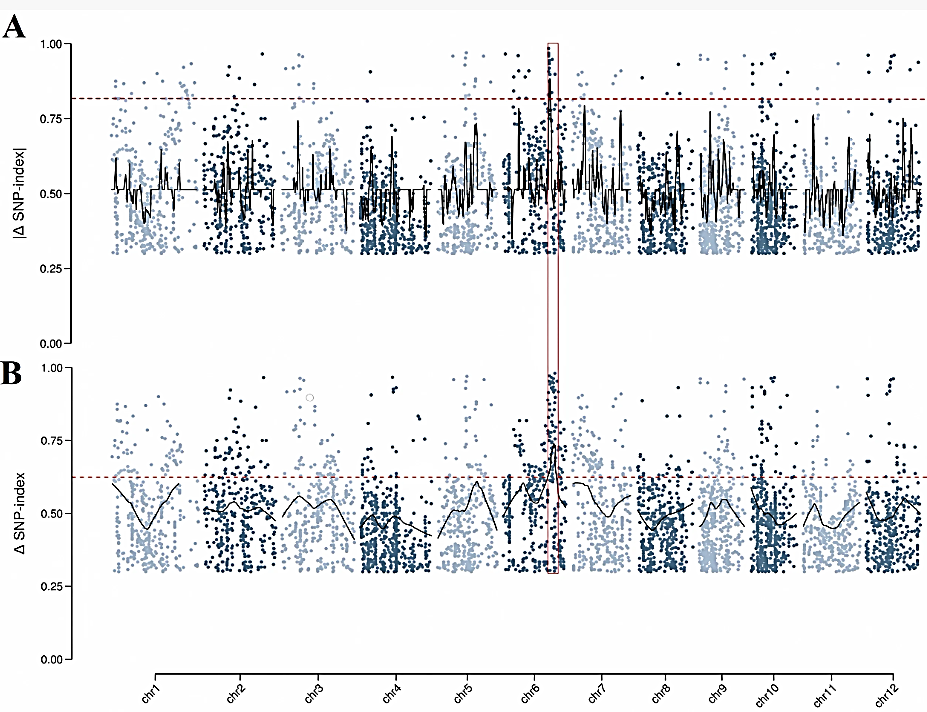
Figure 2: QTL-seq mapping of rice alkalinity tolerance at the seedling stage. (A, B) Manhattan plots for index-slid and index-loess across chromosomes. The red line represented the use of 0.995 quantiles as a threshold for sliding window results. Chromosome numbers were indicated on the x-axis.
Views: 90