


Modeling Control of Invasive Fire Ants by Gene Drive
Yiran Liu, Samuel E. Champer, Benjamin C. Haller, Jackson Champer
Advance Science; 27 October 2025; https://doi.org/10.1002/advs.202504653
Abstract
The fire ant Solenopsis invicta is characterized by aggressive behavior and exceptional invasive capabilities, rendering conventional control methods largely ineffective. Here, we consider homing suppression gene drive in fire ants by developing a spatially explicit model that incorporates both monogyne and polygyne colonies. Ants may present unique challenges for gene drive due to their colony structure and haplodiploidy. Results show that after an extended period of time, gene drive effectively eliminates polygyne colonies, but monogyne populations can persist at low level. Though standard suppression drives in haplodiploids have reduced power, new dominant-sterile resistance or two-target strategies, as well as drives that affect the colony structure, can restore high suppressive capability. Interspecific competition can also exert a positive effect on gene drive suppression, especially if released during an initial invasion, enabling native ants to successfully recolonize their original habitats. Further, we identified several gRNA targets in conserved female fertility genes that may support efficient, low-resistance suppression drive designs. Overall, we conclude that while gene drive in fire ants may take place over extended time scales, its long-term results, even with imperfect efficiency, are promising.
See https://advanced.onlinelibrary.wiley.com/doi/10.1002/advs.202504653
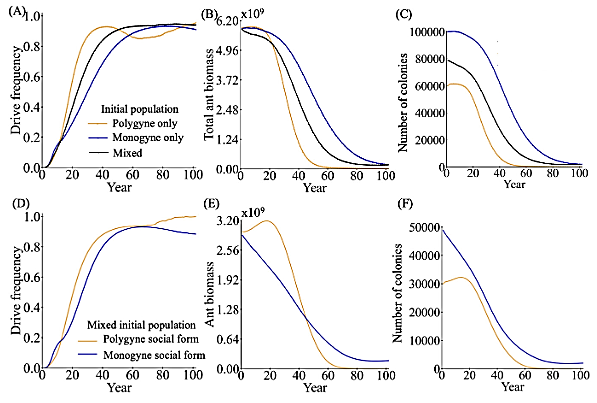
Figure 2: Homing suppression gene drive in fire ant populations. Drive males were introduced into the spatial fire ant population. We examined fire ant populations that were composed only of monogyne colonies, only polygyne colonies, or a mix of both, with each occupying 50% of the initial territory. We display the A) drive frequency, B) total fire ant biomass (in units equivalent to the size of an average monogyne colony worker), and C) number of colonies in each model. For the mixed population, we also separately track the D) Drive frequency, E) ant biomass, and F) number of colonies for each social form. Each line shows the average of 200 simulations.
Views: 164