


Metagenomic and biogenic amine changes in cassava fermentation for tucupi production using Pediococcus acidilactici starter culture
Danielle Gama Brício, Maria Beatriz A Gloria, José Augusto Pires Bitencourt, Leandro Araujo Argôlo, Rafaela de Lima Ribeiro, Ilzane Abreu da Silva, Rosinelson da Silva Pena, Alessandra Santos Lopes, Gilson Ca Chagas Junior, Nelson Rosa Ferreira
J Sci Food Agric.; 2026 Mar 15;106(4):2424-2436. doi: 10.1002/jsfa.70350.

Abstract
Background: The use of starter cultures is essential for producing fermented foods with desirable standardized characteristics and for preventing pathogens. Pediococcus acidilactici, isolated from cocoa fermentation, was used in the production of tucupi, a widely appreciated sauce made from the juice of cassava root (manipueira) in the Brazilian Amazon. Manipueira was submitted to fermentation with and without Pediococcus acidilactici inoculum at 1 × 10¹² CFU mL-1 (Pa treatment and control treatment (CT), respectively), over a 24-h period. Samples were collected at 4-h intervals and analyzed for physicochemical characteristics following official methods, bioactive amines by high-performance liquid chromatography with fluorescence detection (HPLC-FLD), and microbial genera identification by metagenomic analysis.
Results: Physicochemical results indicated that fermentation took its due course, with increased acidity, as well as lower pH and reducing and total sugars (Tukey test, P ≤ 0.05). Only two biogenic amines were detected (putrescine and histamine), and higher levels were found in Pa treatment compared to CT, probably due to the increased Lactobacillus prevalence. Six genera were identified in CT (Weissella, Lactobacillus, Lactococcus, Leuconostoc, Bacillus, and Enterococcus), whereas seven were in Pa (Weissella, Lactobacillus, Pediococcus, Lactococcus, Leuconostoc, Streptococcus, and Enterococcus). Weissella, which was predominant in manipueira, decreased during fermentation, whereas Lactobacillus became predominant in CT. However, when P. acidilactici was used, Lactobacillus was prevalent throughout fermentation, and there was a reduced prevalence of Bacillus and Enterococcus, bacteria with pathogenic potential.
Conclusion: The starter culture optimized tucupi production by maintaining low levels of biogenic amines, inhibiting the growth of undesirable microorganisms, and enhancing tucupi quality and safety.
See https://pubmed.ncbi.nlm.nih.gov/41287997/
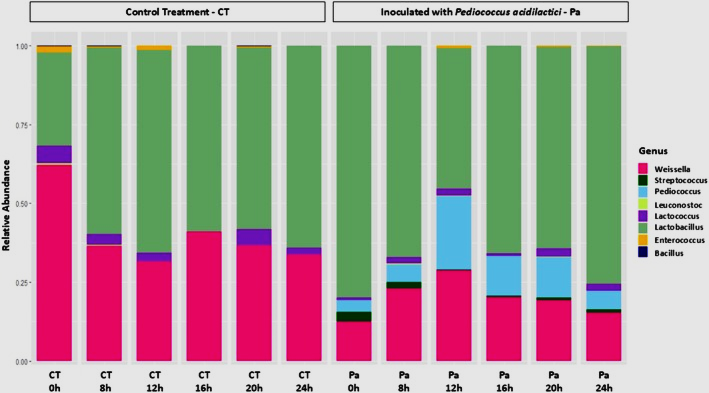
Figure 1
Relative abundance of microbial genera during manipueira fermentation without starter culture (control treatment, CT) and with the inoculation of Pediococcus acidilactici (Pa) as starter culture. The graph shows the shifts in microbial composition across fermentation time points, highlighting the dominance of lactic acid bacteria in the inoculated treatment. These changes illustrate how starter addition influences microbial succession, promoting the prevalence of beneficial fermentative taxa and accelerating the stabilization of the microbial community.
Views: 132