


Mapping flowering time QTLs in watermelon wild relative Citrullus amarus
Venkata Rao Ganaparthi, Patrick Wechter, Amnon Levi & Sandra E. Branham
Theoretical and Applied Genetics; December 10 2025; vol. 139; article 3
Key message
Widely used rootstock ‘Carolina strongback’ delays female flowering of scion(s). Two stable QTLs influencing female flowering time and fruiting time across the seasons and years were identified on chromosome 3.
Abstract
Inbred lines of Citrullus amarus, a wild relative of cultivated watermelon, are widely used as rootstocks to control soil-borne diseases for watermelon (Citrullus lanatus) production. The most commonly used watermelon rootstock, ‘Carolina strongback’ (Syngenta, Basel, Switzerland) flowers weeks later than commercial watermelon cultivars, which delays the onset of female flowering (DFF) of the scion, leading to an undesirable delay in fruit maturity and harvesting. Understanding the genetics of DFF in a C. amarus population will facilitate the development of rootstocks with the early flowering habits preferred for commercial production. A recombinant inbred line population (N = 129 lines) developed between C. amarus lines, USVL246-FR2 and USVL114, was evaluated in field trials in spring and fall of 2022 and 2023 for DFF and days to fruiting (DFT) after being transplanted into the field. The correlation between DFF and DFT is 0.92. Broad-sense heritability of DFF and DFT was 0.23 and 0.31, respectively. Two QTLs influencing both the DFF and DFT across the seasons and years were identified at 90.5 and 56.0 cM on chromosome 3 and together explained 39.7% variance of DFF. Two additional QTLs associated with DFF were season-specific with a spring and a fall QTL on chromosome 10 and on the proximal end of chromosome 3, respectively. Genes coding for putative proteins involved in inducing anthesis, activation and regulation of FT proteins were identified in the 1.5 LOD interval of the stable major QTLs on chromosome 3.
See: https://link.springer.com/article/10.1007/s00122-025-05104-6
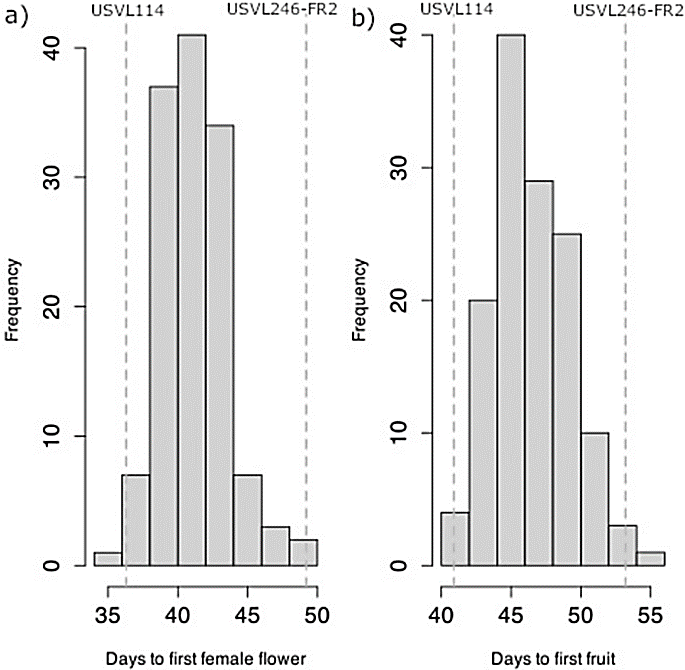
Figure 1: Histogram showing the distribution of a Citrullus amarus mapping population developed between USVL246-FR2 and USVL114
a. days to appearance of first female flower
b. days to the appearance of first fruit after transplanted into the field across the spring and fall seasons of 2022 and 2023. Vertical dashed lines indicate the DFF and DFT of the parents; USVL114 and USVL246-FR2
Views: 148