


Loss of calcium-dependent protein kinases OsCPK5 and OsCPK13 leads to NLR-dependent resistance in rice
Zhanchun Wang, Shibo Yu, Wencai Xu, Han Peng, Xuan Zhou, Anja Liese, Lilan Chen, Guitao Zhong, Chen Zhong, Xianya Deng, Libo Han, Na Liu, Justin Lee, Tina Romeis, Dingzhong Tang, and Wei Wang
PNAS; November 4, 2025; 122 (45) e2506856122; https://doi.org/10.1073/pnas.2506856122
Significance
Calcium-dependent protein kinases (CPKs/CDPKs) play critical roles in plant immunity by serving as both calcium ion (Ca2+) sensors and decoders that transduce Ca2+ signals into phosphorylation reactions in plant cells. Despite their key roles in plant immunity, there is no evidence yet for CPKs targeted by pathogen effectors. However, whether CPKs can be guarded by intracellular nucleotide-binding, leucine-rich repeat receptors (NLRs), similar to other key immune components, remains unclear. Here, we show that OsCPK5 and OsCPK13 contribute to rice blast resistance but that the loss of both leads to increased resistance, which is dependent on the NLR protein OsCPK5/13-ASSOCIATING RESISTANCE PROTEIN 1, extending our understanding that CPKs are also guarded by NLRs.
Abstract
Calcium (Ca2+) signaling plays a crucial role in plant immunity, regulating both pattern-triggered immunity (PTI) through cell-surface receptors and effector-triggered immunity (ETI) via intracellular nucleotide-binding, leucine-rich repeat receptors (NLRs). Calcium-dependent protein kinases (CPKs/CDPKs) serve as key Ca2+ sensors and signal transducers in these processes. In this study, we demonstrate the relevance of two rice CPKs, OsCPK5 and OsCPK13, for rice blast resistance. Both are Ca2+-responsive kinases, with potential in planta heteromer formation enhancing their phosphorylation/signaling functions. Single oscpk5 and oscpk13 mutants exhibit impaired early PTI responses and enhanced susceptibility to rice blast fungus, suggesting that these kinases are essential for effective immunity. Surprisingly, although it is also defective in PTI, the oscpk5/13 double mutant displays enhanced resistance to rice blast. An NLR protein OsCPK5/13-ASSOCIATING RESISTANCE PROTEIN 1 (OsCARP1), which is physically associated with both OsCPK5 and OsCPK13, is genetically required for the heightened resistance of oscpk5/13. Furthermore, OsCARP1-induced cell death in Nicotiana benthamiana can be suppressed by the expression of OsCPK5 and OsCPK13. Based on these findings, we postulate that the positive blast resistance roles of OsCPK5 and OsCPK13 are guarded by OsCARP1, thus leading to OsCARP1-dependent ETI resistance in the oscpk5/13 double mutant or upon manipulation by still unknown pathogen effectors during infection. Our results offer insights into how plants counteract potential pathogen attack on key Ca2+ signaling immune components.
See https://www.pnas.org/doi/10.1073/pnas.2506856122
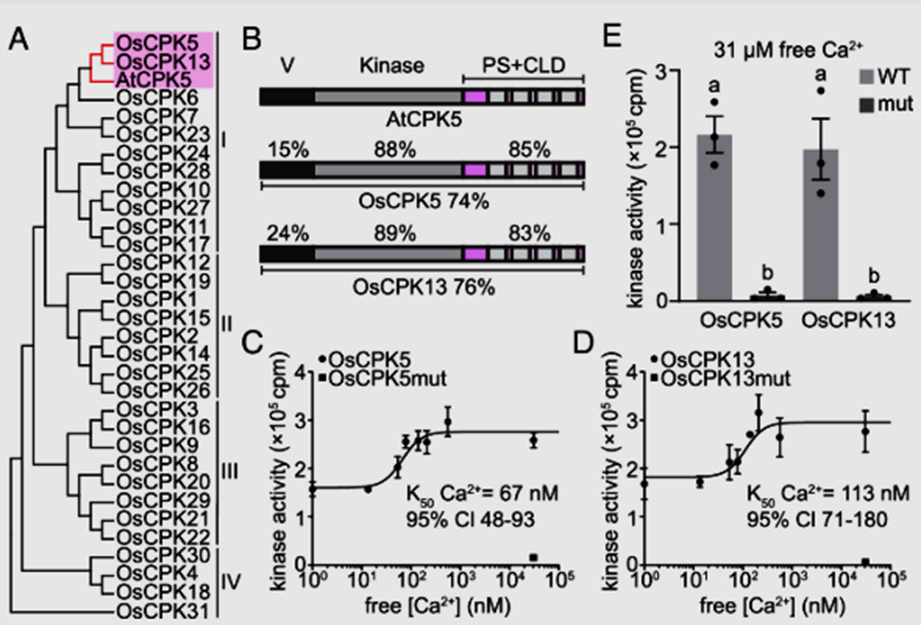
Figure 1:
Ca2+ dependency kinase activity of the OsCPK5 and OsCPK13 enzymes. (A) Phylogenetic tree of CPKs from Arabidopsis and rice. The phylogenetic tree was created based on the amino acid sequences using MEGA6. Four distinct phylogenetic groups are marked from I to IV. OsCPK5 and OsCPK13 are homologs of AtCPK5, which are marked with a pink background. (B) Schematic diagrams of OsCPK5, OsCPK13, and AtCPK5, which display the variable domain (V), kinase domain (Kinase), pseudosubstrate segment (PS), and calmodulin-like domain (CLD) containing four EF-hand motifs (bright boxes). The numbers indicate the percentages of identical amino acids between OsCPK5/13 and AtCPK5. (C and D) In vitro kinase activities of OsCPK5 and OsCPK13. GST-tagged OsCPK5 and OsCPK13 as well as OsCPK5mut (K121M) and OsCPK13mut (K117M) with ATP-binding deficiencies were expressed in Escherichia coli and affinity purified. In vitro kinase activity was determined with [γ-32P]-ATP with different Ca2+ concentrations for 20 min at 22 °C. Radioactive-labeled substrate Syntide 2 was detected by scintillation counting [counts per minute (cpm)]. Analyses of kinase activities were performed using a four-parameter logistic equation with a global model with shared hill slope and half-maximal in vitro kinase activity for Ca2+ (K50) for 3 experiments. Indicated K50 value and 95% CI are derived from three independent experiments. (E) OsCPK5 and OsCPK13 kinase activity at saturating Ca2+ concentrations (31 µM free Ca2+). Means from three independent experiments are shown as individual data points. Statistical analysis was performed using a one-way repeated-measures ANOVA followed by Tukey’s post hoc test (P < 0.05). Values from each experiment were treated as matched observations. Different letters indicate statistically significant differences.
Views: 315