


High-throughput genetic transformation and genome editing in pearl millet (Pennisetum glaucum L.)
V. Mohan Murali Achary, L. Ruben B. Hernandez, Huirong Gao, Ning Wang, Ana I. R. Castillo, Todd Jones, Sarah J. Hearne, Anindya Bandyopadhyay
Plant Physiology; 2025, 199, kiaf499 https://doi.org/10.1093/plphys/kiaf499
Advance access publication 5 November 2025
Pearl millet (Pennisetum glaucum L.), a C4 grass, accounts for 50% of total millet area in terms of global production (Ramu et al. 2023). It plays an important role in food and nutritional security for more than 90 million people in arid regions of Sub-Saharan Africa and Asia (Yadav et al. 2021). This crop exhibits an inherent capacity to adapt to drought and elevated temperatures, displaying resilience against saline and acidic soil conditions, rendering it particularly well-suited for utilization in marginal lands with low fertility. Pearl millet is gaining recognition as a critical alternative crop for food, animal feed, and fodder in numerous regions globally, including Australia, Brazil, Mexico, the United States, Canada, North Africa, and West and Central Asia (Yadav et al. 2021). It is gluten-free and has a low glycemic index. Additionally, it serves as a rich source of calcium, essential micronutrients such as iron and zinc, and a notable protein source. Genetic advancements in pearl millet have been relatively limited thus far, primarily achieved through breeding initiatives. Several agronomically important traits, including resistance to fungal diseases (downy mildew, blast, rust, smut, and ergot), tolerance to terminal drought, enhancements in grain and fodder quality, and reduced flour rancidity, have been recognized as crucial priorities from the farmers’ perspective, thereby necessitating expedited genetic enhancement efforts in pearl millet (Yadav et al. 2021). Despite its significance as a climate-resilient crop for food and nutritional security, pearl millet has not received much focus for genetic improvement due to challenges associated with genetic transformation and in vitro regeneration. In the present work, we established an efficient genetic transformation and genome editing method in pearl millet using immature embryos, aided by morphogenic regulator (MR) genes and a helper plasmid.
The present genome editing system, featuring robust expression of the Cas9 and sgRNA components along with a helper plasmid, can establish a highly efficient platform for precision genetics to generate targeted genome modifications in other elite pearl millet germplasm for trait improvement.
See https://www.cimmyt.org/content/uploads/2025/11/PLANT-PHYS.pdf
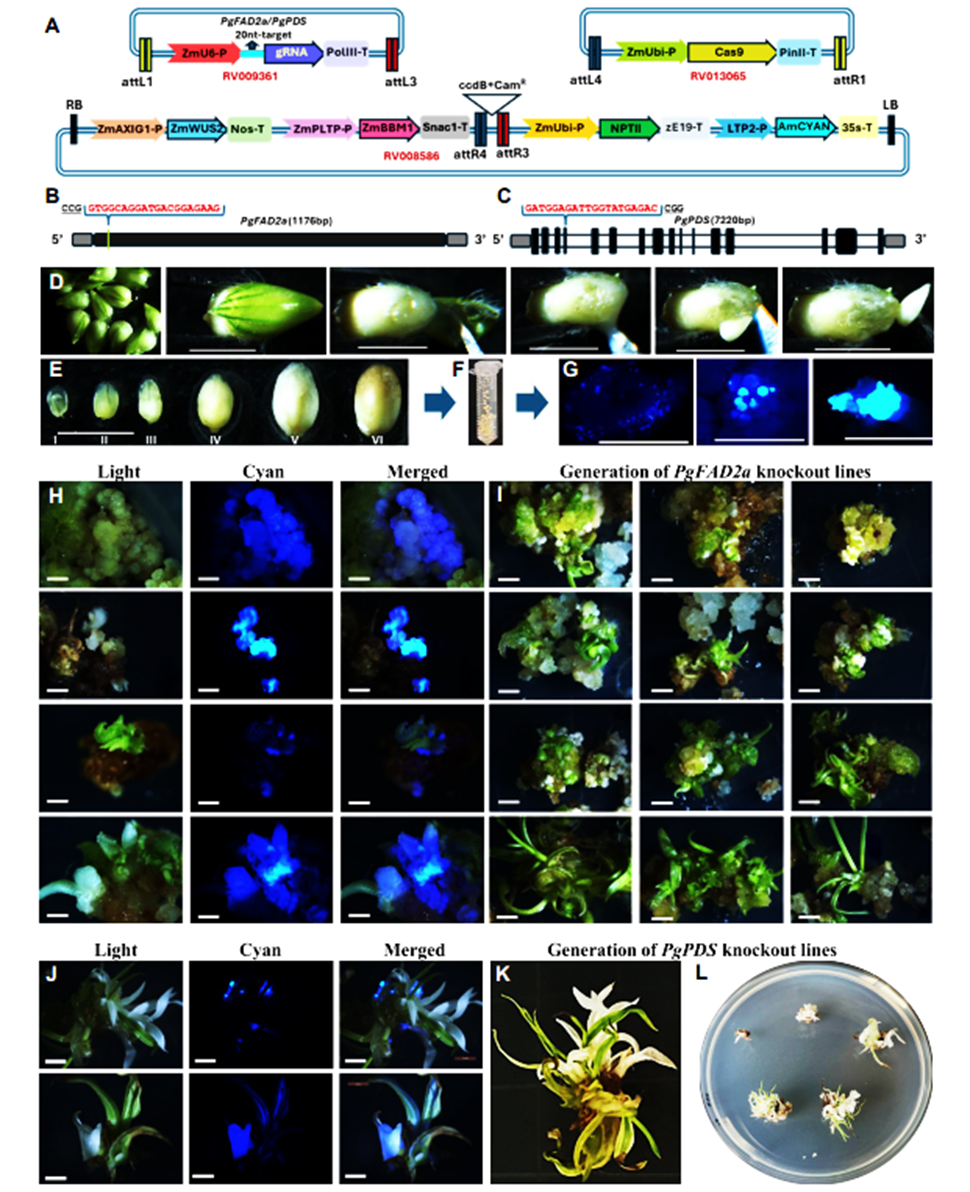
Figure 1. The figures represent genome editing vector constructs used, fatty acid desaturase 2a (FAD2a) and phytoene desaturase (PDS) gene structures, and tissue culture development of knockouts in pearl millet. A) Schematic representation of vector constructs used. The binary destination vector (DV; RV008586) harboring expression cassette of morphoregulator genes WUS2 and BBM1, a visual fluorescent reporter gene Anemonia majano CYAN (AmCYAN), and a neomycin phosphotransferase II (NPTII) gene. The RV013065 entry vector contains the Cas9 expression cassette under Z. mays polyubiquitin1 promoter (ZmUbi1P) and the entry vector RV009361 comprises a gRNA expression cassette under maize U6 promoter. B) The genomic architecture of PgFAD2a gene having single exon and location of sgRNA targeted region within the coding region of PgFAD2a. C) The genomic architecture of the PgPDS gene has 16 exons interrupted by 15 introns, and the sgRNA target region is within the 4th exon. D) Process of isolation of immature embryo following 2 wk post pollination from the developing pearl millet seeds. E) Different types of immature embryo. F) Collection of IEE in the infection medium. G) Expression of AmCYAN on the surface of IEE after 15 d of agroinfection. The subsequent figures in the same panel show development of secondary callus expressing AmCYAN in the selection medium. H) The figures illustrate the different stages of regeneration of the plant from the callus exhibiting AmCYAN expression. I) The figures illustrate the regeneration of plants from the transformed calli from the PgFAD2a knockout construct. J to L) Generation of PgPDS knockout plant showing white strip on the leaf surface. The scale bar represents 2 mm.
Views: 123