


GmBSK1-GmGSK1-GmBES1.5 regulatory module controls heat tolerance in soybean
Ze-Hao Hou, Yuan Gao, Jia-Cheng Zheng, Meng-Jie Zhao, Ying Liu, Xiao-Yu Cui, Zhi-Yong Li, Ji-Tong Wei, Tai-Fei Yu, Lei Zheng, Yuan-Chen Jiao, Shu-Hui Yang, Jia-Min Hao, Jun Chen, Yong-Bin Zhou, Ming Chen, Lijuan Qiu, You-Zhi Ma, Zhao-Shi Xu
J Adv Res.; 2025 Jul:73:187-198. doi: 10.1016/j.jare.2024.09.004.

Abstract
Introduction: Heat stress poses a severe threat to the growth and production of soybean (Glycine max). Brassinosteroids (BRs) actively participate in plant responses to abiotic stresses, however, the role of BR signaling pathway genes in response to heat stress in soybean remains poorly understood.
Objectives: In this study, we investigate the regulatory mechanisms of GmBSK1 and GmBES1.5 in response to heat stress and the physiological characteristics and yield performance under heat stress conditions.
Methods: Transgenic technology and CRISPR/Cas9 technology were used to generated GmBSK1-OE, GmBES1.5-OE and gmbsk1 transgenic soybean plants, and transcriptome analysis, LUC activity assay and EMSA assay were carried out to elucidate the potential molecular mechanism underlying GmBSK1-GmBES1.5-mediated heat stress tolerance in soybean.
Results: CRISPR/Cas9-generated gmbsk1 knockout mutants exhibited increased sensitivity to heat stress due to a reduction in their ability to scavenge reactive oxygen species (ROS). The expression of GmBES1.5 was up-regulated in GmBSK1-OE plants under heat stress conditions, and it directly binds to the E-box motif present in the promoters of abiotic stress-related genes, thereby enhancing heat stress tolerance in soybean plants. Furthermore, we identified an interaction between GmGSK1 and GmBES1.5, while GmGSK1 inhibits the transcriptional activity of GmBES1.5. Interestingly, the interaction between GmBSK1 and GmGSK1 promotes the localization of GmGSK1 to the plasma membrane and releases the transcriptional activity of GmBES1.5.
See https://pubmed.ncbi.nlm.nih.gov/39236976/
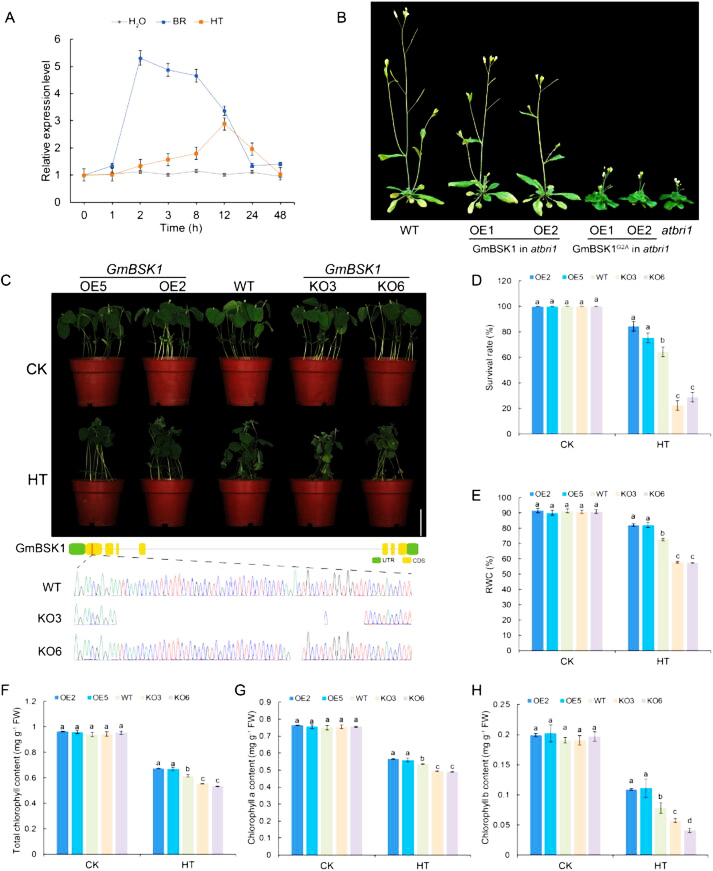
Figure 1
GmBSK1 is a heat tolerance regulator. (A) Expression patterns of the GmBSK1 gene under heat stress and BR treatments determined by RT-qPCR analysis. (B) Phenotypic analysis WT, atbri, or transgenic atbri overexpressing GmBSK1 and GmBSK1-G2A. (C) Identification of CRISPR/Cas9-gmbsk1 soybean mutant plants, and phenotypic analysis of different plants under heat stress; Bar = 10 cm (D) Survival rate of different lines under heat stress; (E) Relative water content (RWC) of different lines under heat stress. (F-H) Chlorophyll content of different plants under heat stress. Different letters indicate means that were significantly different at p < 0.05
Views: 229