


GmAP1 delays flowering time and confers sensitivity to salt stress in soybean
Guang Yang, Jianxin Liu, Miao Liu, Hong Zhai, Chao Fan, Wenwei Liang, Shufeng Di, Yongcai Lai, Guohua Ding, Wei Li, Yingdong Bi
Plant Physiology and Biochemistry; March 2026; volume 232; 11163
Abstract
Aspartic proteases represent a class of proteolytic enzymes widely implicated in plant growth regulation and abiotic stress responses. Our previous work identified an aspartic protease, GmAP1, whose expression is strongly correlated with flowering time in wild soybean populations. In this study, we further demonstrated that GmAP1 overexpression (OE) significantly delays flowering, whereas CRISPR/Cas9-mediated knockout (CR) accelerates this process. Specifically, OE lines exhibited suppressed expression of CONSTANS (CO) and FLOWERING LOCUS T (FT), along with elevated transcript levels of FLOWERING LOCUS C (FLC). Subcellular localization assays confirmed that GmAP1 is targeted to chloroplasts, where it downregulates the PHD-type transcription factor gene PTM without affecting GOLDEN2-LIKE 1/2 (GLK1/2). Notably, GmAP1 expression was strongly induced by salt stress. GmAP1-OE lines exposed to salt stress showed chlorophyll degradation and reduced net photosynthetic rate (Pn). Both in vivo and in vitro biochemical assays verified that GmAP1 interacts with and degrades the Rubisco large subunit (rbcL), a process correlating with decreased Pn and delayed flowering in OE lines under salt stress. Collectively, our findings reveal that GmAP1 coordinates photosynthetic energy supply and reproductive transition in soybean. Precise modulation of this gene holds substantial practical value for developing early-maturing, salt-tolerant soybean varieties well adapted to saline-alkali environments.
See: https://www.sciencedirect.com/science/article/pii/S098194282600149X
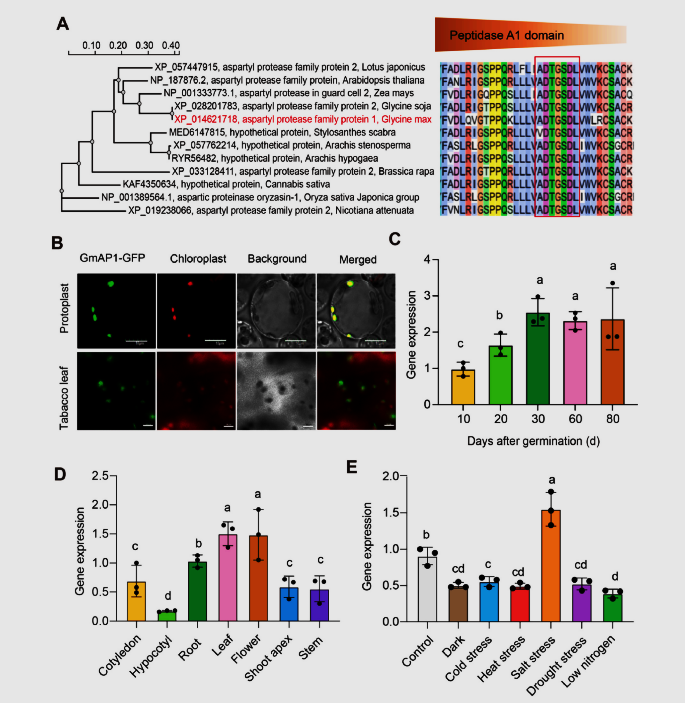
Figure 1:
Phylogenetic analysis and spatiotemporal expression profiling of GmAP1 and its orthologs across plant species. A, Phylogenetic tree of GmAP1 orthologs in different plant species. The ADTGSDL active sites of the peptidase A1 domain are highlighted in the box. The peptidase domain was predicted using the InterPro database (https://www.ebi.ac.uk/interpro/). B, Subcellular localization of GmAP1 in tobacco leaves and Arabidopsis mesophyll protoplasts. C, GmAP1 expression levels in different soybean organs. D, GmAP1 expression levels at different soybean developmental stages. E, GmAP1 expression levels in soybean leaves in response to different abiotic stresses. For panels C–E, data are presented as mean ± SD (n = 3). Different lowercase letters indicate significant differences determined by oneway ANOVA followed by Tukey's HSD test (P < 0.05).
Views: 116