


Genomic prediction-aided incorporation of genetic resources into elite breeding: lessons from a collaborative multiparental design in flint maize
Dimitri Sanchez, Sarah Ben Sadoun, Tristan Mary-Huard, Cyril Bauland, Carine Palaffre, Bernard Lagardère, Delphine Madur, Valérie Combes, Stéphane Melkior, Laurent Bettinger, Alain Murigneux, Laurence Moreau & Alain Charcosset
Key message
A public private cooperative mating design between elite maize inbred lines and diversity donors shows that genomic prediction holds great promise to improve the use of genetic resources.
Abstract
Genetic diversity is essential for plant breeding, enabling long-term gains and adaptation to climate change and new agronomical practices. Breeders can access diverse genetic resources to enhance elite germplasm and introduce new favorable variations. The limited performance of genetic resources may hamper their use. To overcome this, a bridging population can be implemented to evaluate and select progenies from crosses between diversity donors and elite lines before their introduction in breeding programs. The choice of such crosses can be dealt with the usefulness criterion (UC), which determines its ability to produce transgressive individuals. This paper investigates the use of genome-wide marker effects to predict (i) the performance of individuals derived from crosses between donors and elite lines and (ii) the UC of crosses not observed yet. It also compares donor introduction strategies based on the UC or the H criterion, which considers the genome-wide donor–elite complementarity. We used a flint maize collaborative multi-parental BC1-S2 population, consisting in materials from six breeding companies and one public institute crossed to different donors. The 20 crosses had contrasted means and genetic variances, and most of them presented transgressive individuals above the elite parent. Results emphasize the importance of half-siblings derived from the elite line parent of the predicted cross to efficiently predict progeny performances or the UC. They also showed that using the H criterion appears promising to select iteratively donors that best complement initial elite materials. The paper concludes with guidelines for implementing a bridging population using genome-wide marker-based predictions.
See https://link.springer.com/article/10.1007/s00122-025-05034-3
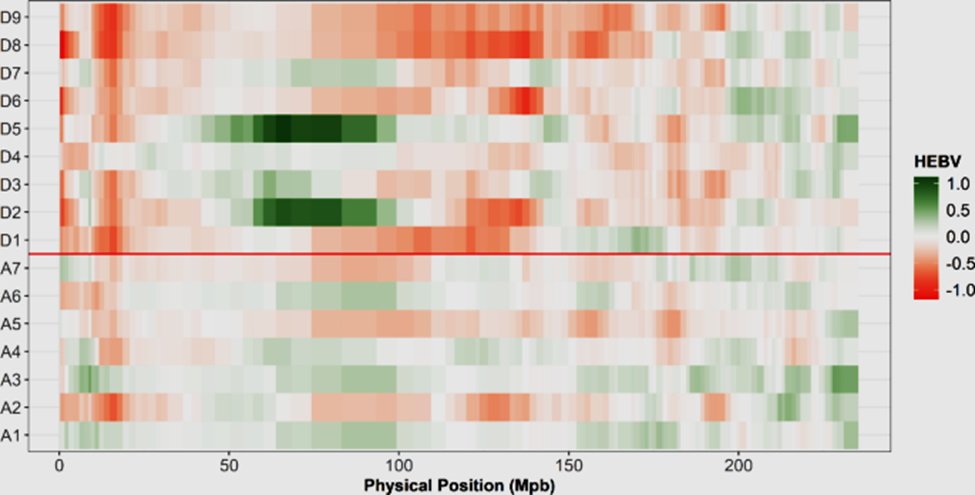
Figure 5: Visualization of the HEBVs with overlapping segments (100 SNPs with 20 SNP increment) for the grain yield along the chromosomes3. For each trait, the HEBVs were computed along the genome using marker effects estimated with a BRR model calibrated with all individuals of the dataset (twenty families). The x-axis represents the mean physical position of each haplotype segment in Mpb
Views: 181