


Genome-wide characterization of soybean alcohol dehydrogenase (ADH) genes identifies GmADH13 as a positive regulator of the salt stress response
Sihui Wang, Zhiyuan Xu, Peng Cheng, Jun Yang, Qiang Hao, Jinfang Wang, Ziqian Cheng, Lingshi Xia, Zhenbang Hu, Xin Li & Anyu Su
TAG; March 6 2026; vol. 139; article 89
Abstract
Alcohol dehydrogenase (ADH) is a zinc-binding enzyme responsible for catalyzing the interconversion between ethanol and acetaldehyde, as well as other alcohol and aldehyde pairs, within the ethanol fermentation pathway. This enzyme plays a crucial role in plant adaptation to environmental stressors. However, knowledge regarding the ADH gene family in soybean remains limited. Here, a genome-wide analysis was conducted, leading to the identification of 22 ADH genes in soybean and their classification into five subfamilies based upon phylogenetic relationships. Cis-regulatory element analysis combined with qRT-PCR experiments demonstrated that GmADH genes exhibit significant upregulation on exposure to various abiotic stresses, such as drought, alkaline conditions, and salt stress, as well as to hormonal stimuli. Furthermore, GmADHs display distinct tissue-specific expression patterns. Notably, GmADH13 showed consistent upregulation across multiple stress conditions, suggesting its pivotal role in soybean’s salt stress response. Functional analyses revealed that GmADH13 enhances salt tolerance by modulating the reactive oxygen species scavenging system, maintaining redox homeostasis, and stabilizing Na⁺/K⁺ levels within cells, thereby reducing oxidative damage induced by salt stress. The results from transgenic hairy root experiments further support the role of GmADH13 in improving salt tolerance. Collectively, this study expands the current understanding of the ADH gene family's involvement in soybean stress responses and highlights potential genetic targets for enhancing soybean salt tolerance during cultivation.
See https://link.springer.com/article/10.1007/s00122-026-05189-7
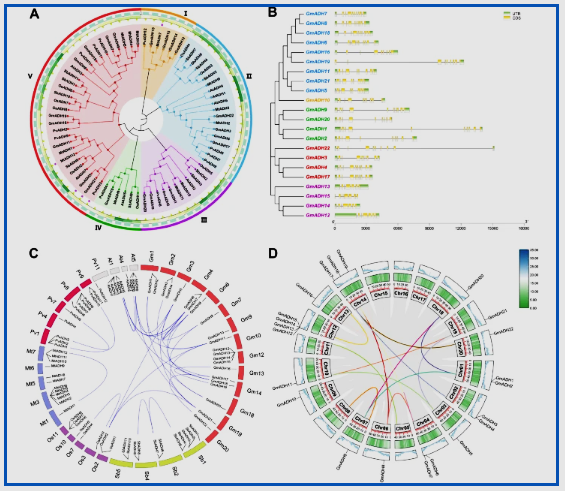
Figure 1: Phylogenetic, gene structure, and collinearity analyses of GmADH genes. A Analysis of the evolution of ADH family proteins in Arabidopsis thaliana, Glycine max, Oryza sativa, Medicago truncatula, Phaseolus vulgaris, and Sorghum bicolor. B ADH gene structural characteristics. The CDS is marked with a yellow box, while UTR sequences are denoted with a green box. C Collinearity analyses of ADH family genes from A. thaliana, G. max, O. sativa, M. truncatula, P. vulgaris, and S. bicolor. D Collinearity analyses of GmADH genes from soybean. Circles represent chromosomes, with the curves of varying colors denoting syntenic ADH gene areas. Exon and intron sizes are marked with the provided scale
Views: 121