


Generating Broad-Spectrum Resistance to ALS-Inhibiting Herbicides in Rice by CRISPR/Cas9-Mediated NHEJ
Chao Ouyang, Xiongxia Jin, Huimin Zhao, Silan Chen, Guangmiao Zhao, Dan Li, Wei Liu, Xiuying He, Yongzhong Wu, Jing Yang & Baoguang An
Rice volume 18, Article number: 86 (2025); Published: 03 October 2025
Abstract
Herbicides are pivotal for modern agriculture, but challenges like weed resistance and crop rotation issues necessitate the development of herbicide-resistant genetic resources. This study focused on acetolactate synthase (ALS), a key enzyme targeted by numerous herbicides. Using CRISPR/Cas9-mediated non-homologous end joining (NHEJ) and combining with whole-stage selection, we induced mutations in the OsALS gene of indica rice and identified novel in-frame mutations at the P171 and S627 sites, respectively. Among them, one mutation at the P171 site, the triple mutation P171T/R172G/M174L (ALS-TM) conferred broad-spectrum resistance to Imidazolinones Pyrimidinylthiobenzoates Sulfonylaminocarbonyltriazolinones and Sulfonylureas herbicides. Compared to wild-type (WT) rice, ALS-TM showed 1153-fold higher resistance to imazethapyr (IMT) than WT based on GR50 values (The herbicide dose causing a 50% reduction in growth), with minimal growth inhibition at 10-fold IMT treatment. Enzymatic assays revealed that ALS-TM maintained catalytic efficiency while reducing herbicide binding, which validated the resistance at the protein level. Field trials showed that ALS-TM mutant retained normal agronomic traits even after IMT spraying, indicating no yield penalty. Additionally, ALS mutations were validated as effective transgenic selection markers, enabling efficient rice transformation under different selection systems. These results demonstrated that ALS-TM could also serve as a reliable tool in basic research, facilitating the selection and identification of transgenic materials in laboratory studies. This study provided a robust method for generating herbicide-resistant rice germplasm and highlighted the potential of CRISPR-mediated NHEJ for creating novel resistant mutations.
See https://thericejournal.springeropen.com/articles/10.1186/s12284-025-00845-w
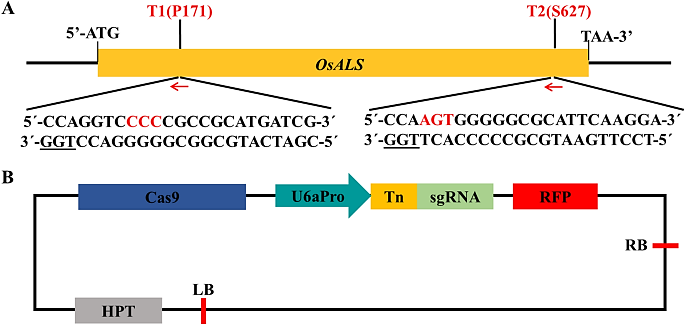
Figure 1
Schematic diagram of the targeted sequence in OsALS and pYLCas9H-ALS vector. A schematic description of the OsALS gene and the targets. The positions of the sgRNAs targeting P171 and S627 sites of OsALS were indicated by a red arrowhead. The target sequences were presented in the form of the antisense strand and the protospacer-adjacent motif (PAM) sequences were underlined. The corresponding P171 and S627 codons were indicated in red. B Schematic diagram of the circular pCRGE-ALS construct. HPT, hygromycin B phosphotransferase cassette; Cas9, Cas9 cassette; U6aPro, OsU6a promoter; Tn, the corresponding target sequence; RFP, red fluorescent protein cassette
Views: 232