


Ethylene-enhanced latex proteome is involved in stimulation of Natural Rubber Production in the Hevea Rubber Tree
Lixia He, Junjun Ma, Boxuan Yuan, Yang Yang, Yongfei Wang, Fengyan Fang, Shaoli Tan, Linglin Yang, Changwei Zhou, Juanying Wang, Wei Li, Shugang Hui, Xuchu Wang
Mol Cell Proteomics; 2026 Jan 28: 101521. doi: 10.1016/j.mcpro.2026.101521.
Abstract
The Hevea brasiliensis is the only commercial source of natural rubber. In natural rubber production, exogenous ethylene is widely used as a stimulant for increasing rubber latex yield. To reveal the potential regulation mechanisms for ethylene stimulation of natural rubber production in H. brasiliensis, we performed an integrative analysis of transcriptomics and proteomics for ethylene-stimulated rubber latex. A total of 35,306 genes and 3,620 proteins were successfully identified from the different latex samples upon ethylene stimulation. Gene ontology analysis revealed these genes are mainly involved in cytoplasm, cytoplasmic and catalytic activity. Kyoto encyclopedia of genes and genomes analysis demonstrated their pathways are mainly enriched in alanine and glutamate metabolism, carbon metabolism, and carbon fixation. Ethylene stimulation played a key regulatory role at the translation/post-translation modification level to promote nature rubber synthesis. Notably, 64 genes and 35 proteins are directly involved in natural rubber biosynthesis. Among them, several family members of 3-hydroxy-3-methylglutaryl coenzyme A reductase (HMGR), small rubber particle protein (SRPP) and cis-prenyl transferase (CPT) are ethylene-responsive ones. It is noteworthy that accumulation of CPT7 was significantly increased after ethylene application. Overexpression of HbCPT7 in a rubber-producing model plant, Taraxacum Kok-saghyz (TKS), resulted in a significant increase for rubber content in the transgenic TKS roots.
See https://pubmed.ncbi.nlm.nih.gov/41617137/
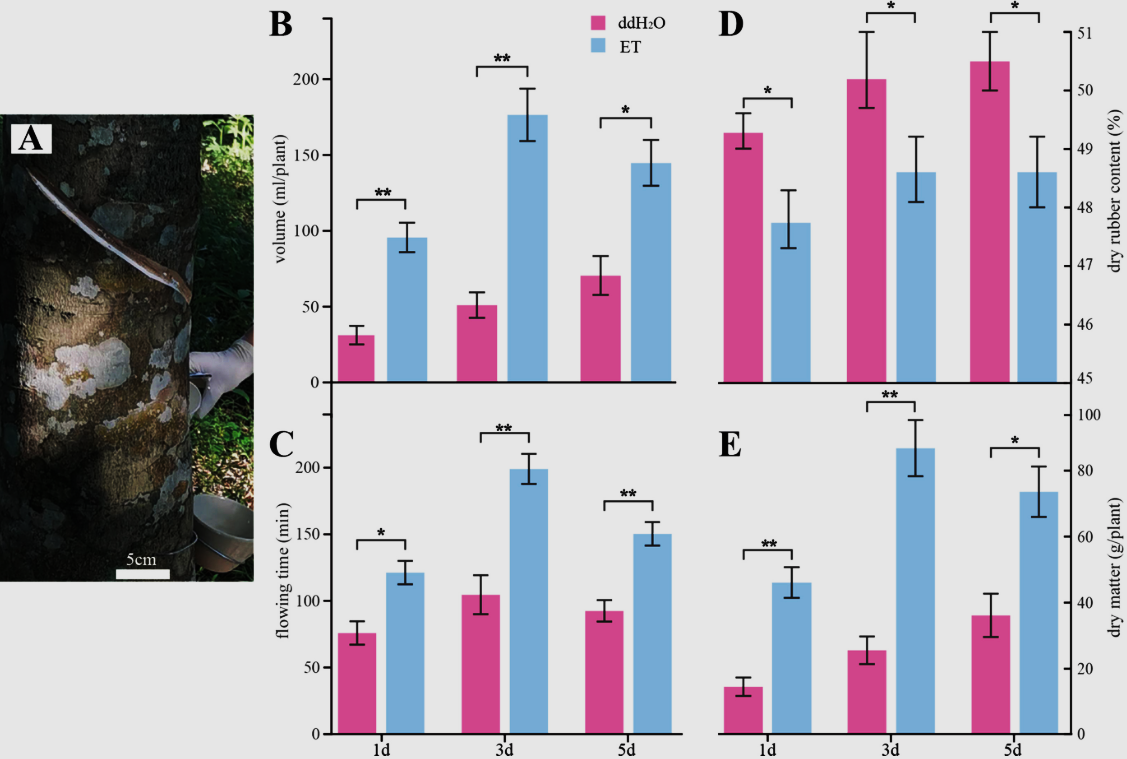
Fig. 1 Changes of latex physiological parameters after ethylene treatments. (A) The virgin rubber tree. (B) Fresh yield. (C) Flowing time. (D) Dry rubber content. (E) Dry matter.
Views: 199