


Enhancing genomic prediction ability of blast resistance using genome-wide association study-derived marker weights in two rice (Oryza sativa L.) populations
Félicien Akohoue, Cristian Camilo Herrera, Silvio James Carabali Balanta, Juanita Torres, Constanza Quintero, Gloria Mosquera & Maria Fernanda Alvarez
TAG; January 30 2026; vol. 139; article 52
Key message
Leaf and panicle blast resistances were moderately correlated and controlled by several genes, including Pi2/Pi9 and Pi33. GWAS-based marker weighting increased GBLUP predictive ability by up to 37% across two rice populations.
Abstract
Breeding for blast resistance remains a high priority in rice (Oryza sativa L.) improvement, yet the genetic complexity of leaf blast (BL) and panicle blast (PB) continues to challenge prediction accuracy in genomic selection (GS). Traditional GS approaches, such as genomic best linear unbiased prediction (GBLUP), assume equal contribution from all markers, potentially limiting the capture of key resistance loci. Recent advances integrating genome-wide association studies (GWAS) into GS offer new opportunities to weight markers based on their biological relevance. In this study, we dissected the genetic architecture of BL and PB resistance in two diverse rice populations and evaluated the performance of three weighted GBLUP models that incorporate marker information from GWAS. Marker weighting strategies included FST-based weighting (FST-w), squared additive effects (AE-w), and − log10(p)-based weighting (− log10(p)-w). We identified significant marker-trait associations (MTAs), including key loci near the Pi2/Pi9 cluster and Pi33 gene regions on chromosomes 6 and 8. A moderate genetic correlation (0.43–0.44) between BL and PB severity suggests partially shared genetic control. Across traits and populations, AE-w and − log10(p)-w models improved predictive ability by 4–37% (0.03–0.23) and reduced normalized root mean square error by 3.8−35.3% relative to the unweighted GBLUP. These results demonstrate the value of integrating GWAS into GS (GS + GWAS) and highlight marker weighting as a practical strategy to enhance prediction accuracy for complex traits like blast resistance, ultimately accelerating genetic gains in rice breeding programs.
See: https://link.springer.com/article/10.1007/s00122-026-05159-z
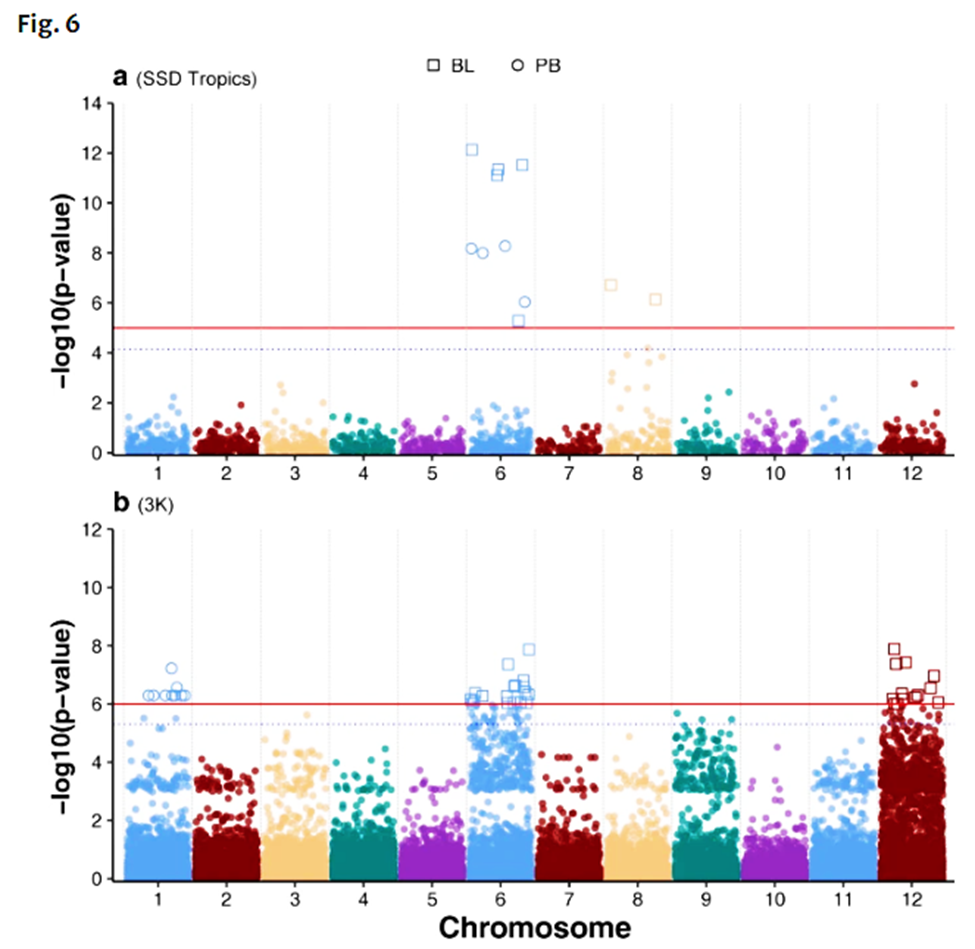
Figure 6:
Manhattan plots showing marker-trait associations for leaf blast (BL) and panicle blast (PB) severity. a = SSD Tropics population and b = 3K population. The red solid line represents the corrected Bonferroni threshold, serving as the cutoff for significant markers
Views: 159