


Enhanced expression of the ScTpx2 gene confers tolerance to drought stress in transgenic sugarcane
Nery Tirabante Terrones, Vanessa Regina Gonçalvesa, Hilde Nelissenc, Nathalie Gonzalezc,Willian Souza Bernardesa, Rodrigo Faleiro de Lima, Juliana Mayer, Dirk Inzéc, and Marcelo Menossi
GM CROPS & FOOD2026, vol. 17, no. 1, 2612426
https://doi.org/10.1080/21645698.2025.2612426© 2026
ABSTRACT
Drought events can have a devastating impact on agriculture, and due to climate change, such extreme events are expected to become more frequent. Sugarcane plays a critical role in the Brazilian economy by producing sugar and bioethanol, contributing positively to the reduction of CO2 emissions. Although sugarcane is considered resilient to drought, this stress remains the primary abiotic factor reducing sugar and biomass yields. Here, we describe the role of a sugarcane gene, ScTpx2, which is induced by drought in sugarcane leaves under field conditions. When overexpressed in Arabidopsis, ScTpx2 enhanced plant survival under extreme water deficit and improved performance under mild stress conditions, which better represent field scenarios. We subsequently overexpressed the ScTpx2 gene in sugarcane plants. After 10 days of water deficit at 30% field capacity in a greenhouse, net photosynthesis in ScTpx2-overexpressing lines (ScTpx2OE) was 12–23% higher than in wild-type plants. While malondialdehyde (MDA) content, a marker of oxidative stress, increased by 129% in wild-type plants under water deficit, in ScTpx2OE plants, the increase ranged from 20% to 107%. Additionally, the vascular bundles and xylem areas were larger in ScTpx2OE compared to WT. These findings suggest that the ScTpx2 protein influences the development of the vascular system, thereby improving water transport efficiency. Our results demonstrate that overexpression of the ScTpx2 gene mitigates the effects of water deficit in sugarcane, offering promising opportunities for biotechnological applications in developing drought-tolerant commercial cultivars.
See: https://www.tandfonline.com/doi/full/10.1080/21645698.2025.2612426#abstract
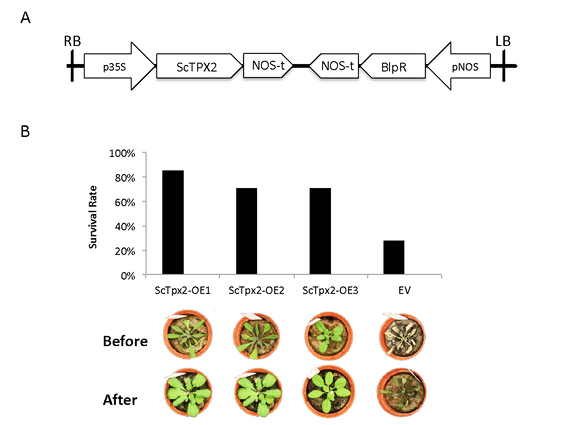
Figure 2: Assessment of tolerance to severe water deficit. A) DNA constructs used to overexpress ScTpx2 in Arabidopsis. (B) survival rates after exposure to drought stress. Ten-day-old Arabidopsis plants were subjected to two weeks of water withdrawal, followed by rehydration. Photos were taken at the end of the withdrawal period (before) one day after rehydration (after), and the percentage of recovered plants was determined. Plants transformed with an empty vector were used as controls. Ten plants from each of the three independent events were assessed, and the experiment was repeated with consistent results (supplementary Figure S1). ScTpx2-OE1, -OE2, and -OE3 indicate independent transgenic lines overexpressing ScTpx2; EV represents plants transformed with pGWB608 lacking the ScTpx2 gene.
Views: 168