


Dual-cycle CO2 fixation enhances growth and lipid synthesis in Arabidopsis thaliana
Kuan-Jen Lu, Chia-Wei Hsu, Wann-Neng Jane, Mien-Hao Peng, Ya-Wen Chou, Pin-Hsuan Huang, Kuo-Chen Yeh, Shu-Hsing Wu, and James C. Liao
SCIENCE; 11 Sep 2025; Vol 389, Issue 6765; DOI: 10.1126/science.adp3528
 Abstract
Carbon fixation through the Calvin-Benson-Bassham (CBB) cycle accounts for the majority of carbon dioxide (CO2) uptake from the atmosphere. The CBB cycle generates C3 carbohydrates but is inefficient at producing acetyl–coenzyme A (CoA) (C2), which is the universal precursor for synthesizing lipids. In this work, we introduced in Arabidopsis thaliana a new-to-nature CO2 fixing cycle, malyl-CoA-glycerate (McG) cycle, which together with the CBB cycle forms a dual-cycle CO2 fixation system. This cycle can fix one additional carbon by phosphoenolpyruvate carboxylase and convert the photorespiration product, glycolate, to acetyl-CoA. Plants with the McG cycle show enhanced protein abundance in their photosystems and enhanced photosystem II efficiency. McG plants had doubled CO2 fixation rates under atmospheric CO2, increased lipid production, pronounced growth enhancement, and tripled the seed yield.
See https://www.science.org/doi/10.1126/science.adp3528
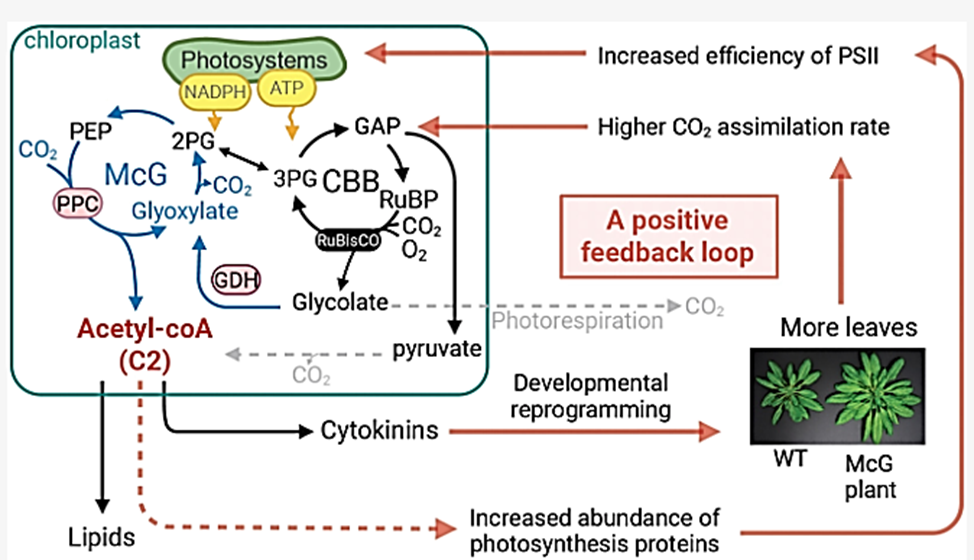
Figure 1:
A C2-centric dual-cycle carbon fixation system in Arabidopsis.
The McG (blue) cycle is introduced to Arabidopsis chloroplasts to work with the native CBB cycle (black) for more efficient acetyl-CoA synthesis and bypassing photorespiration. The McG plants grew much larger and produced more seeds and lipids through a positive feedback loop. [The figure was created with BioRender.com.]
Views: 650