


Decoupled timescales of organic carbon and phosphorus recycling in the global ocean
Megan R. Sullivan, François W. Primeau, Hojong Seo, Judith Camps-Castellà, Keisuke Inomura, and Adam C. Martiny
PNAS; February 17 2026; 123 (8) e2514991123
Significance
The ocean plays a critical role in regulating atmospheric carbon dioxide through the biological carbon pump, which transports organic carbon from surface waters to the deep ocean. However, the efficiency of this process is influenced by the cycling of other essential nutrients, such as phosphorus. This study demonstrates that carbon and phosphorus have distinct residence times in the ocean, challenging assumptions about how much carbon remains sequestered over climate-relevant timescales. Our results suggest that assessments of proposed marine carbon dioxide removal strategies, such as ocean iron fertilization, may be inaccurate if they fail to account for nutrient cycling.
Abstract
The ocean’s biological carbon pump exports atmospheric CO2 to the deep ocean, where it can remain sequestered for decades to centuries, and attempts to artificially enhance this natural carbon sink by fertilizing portions of the open ocean could help mitigate the impacts of excessive anthropogenic CO2 emissions. However, differences in the cycling rates of carbon and other nutrients may impact the long-term response to ocean fertilization. In this study, we use a steady-state global biogeochemical inverse model, optimized to match hydrographic observations, to examine how differential production, remineralization, and circulation-driven re-exposure timescales of organic carbon and phosphorus affect long-term carbon sequestration. We partition global organic matter production based on the time required for regenerated carbon and phosphorus to return to the ocean surface. We find that less than 15% of total organic carbon and 31% of total organic phosphorus production remains sequestered in the ocean interior for 1 y, with only 3.3% (1.8 Pg C y−1) and 8.3% (0.046 Pg P y−1), respectively, remaining for a century or longer. The C:P ratio of the sequestration flux declines with increasing residence time, from 255:1 for total production to 98:1 for material sequestered for 100+ years, indicating that carbon is recycled to the surface more rapidly than phosphorus. This decoupling between carbon and phosphorus sequestration timescales could result in a “productivity hangover,” where the slow recovery of surface phosphate leads to a long-term suppression of global productivity, reducing the net removal of atmospheric CO2.
See https://www.pnas.org/doi/10.1073/pnas.2514991123
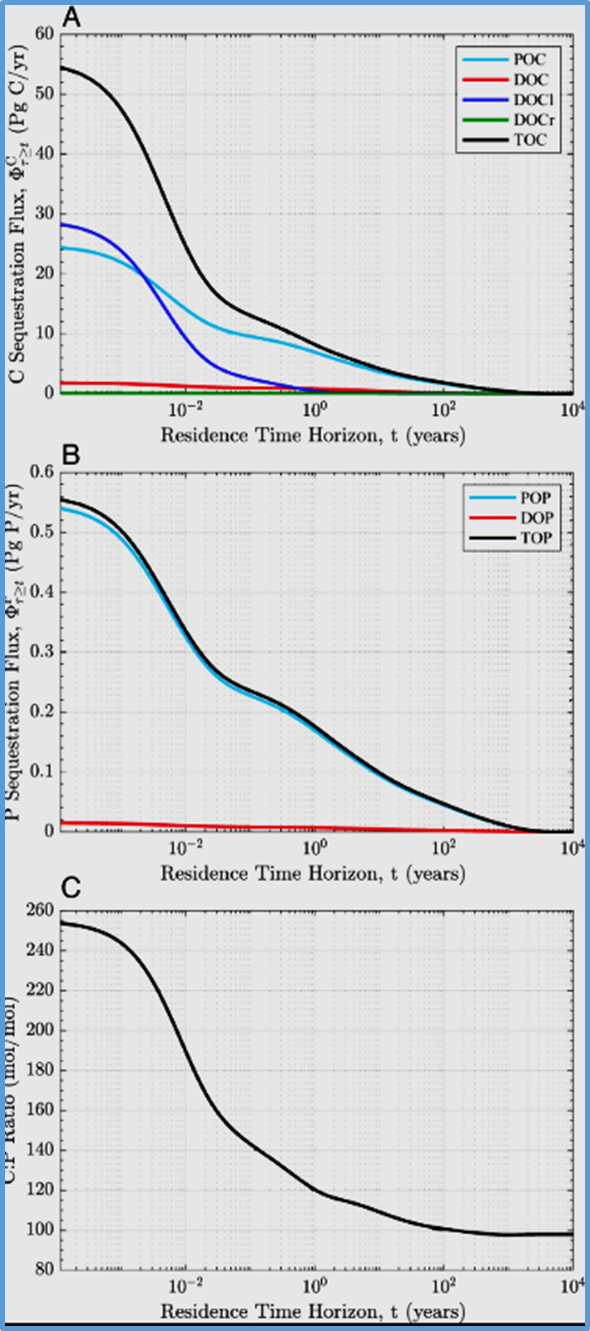
Figure 1
Global sequestration fluxes of carbon () and phosphorus (). Sequestration fluxes are defined as the global production of regenerated organic carbon (A) and phosphorus (B), that remains in the ocean interior for at least years before next coming into contact with the atmosphere. Panel (C) shows the ratio of the total carbon sequestration flux to the total phosphorus sequestration flux () as a function of the residence time horizon, . Note that the residence time horizon, on the x-axis, is on a log scale. In (A and B), total organic carbon (TOC) and total organic phosphorus (TOP) sequestration fluxes (black) are the sum of remineralized particulate organic matter (light blue), semilabile dissolved organic matter (red), labile organic matter (dark blue), and recalcitrant dissolved organic matter (green) production. For a residence time threshold of , the TOC sequestration flux is equivalent to global net primary production (NPP), which is prescribed to match satellite-based climatological estimates from the CbPM algorithm.
Views: 165