


Comparative analysis of genomic prediction approaches for multiple time-resolved traits in maize
David Hobby, Robin Lindner, Alain J. Mbebi, Hao Tong & Zoran Nikoloski
Theoretical and Applied Genetics; February 6 2026; vol. 139; article 63

Abstract
Ability to accurately predict multiple growth-related traits over plant developmental trajectories has the potential to revolutionize crop breeding and precision agriculture. Despite increased availability of time-resolved data for multiple traits from high-throughput phenotyping platforms of model plants and crops, genomic prediction is largely applied independently to a small number of traits, often neglecting their dynamics. Here, we compared and contrasted the performance of MegaLMM and dynamicGP as well as hybrid variants, using MegaLMM in place of RR-BLUP for component matrix prediction, which can handle high-dimensional temporal data for multi-trait genomic prediction. The comparative analysis made use of time series for 50 geometric, color, and texture traits in a maize multi-parent advanced generation inter-cross (MAGIC) population. The performance of the approaches was assessed using snapshot and longitudinal accuracy, quantified as the Pearson correlation (PCC) and mean squared error (MSE), thereby providing insight into the ability to predict multiple traits at a single time point or the dynamics of individual traits over the considered time domain, respectively. We found that MegaLMM outperforms dynamicGP in terms of both snapshot and longitudinal PCC over an observed time interval, but not in terms of snapshot MSE. We also analyzed the characteristics of trait developmental trajectories associated with predictive performance. This study goes further to demonstrate that dynamicGP is the only time-dependent genomic prediction approach which can forecast multiple traits beyond the set of training time points and paves the way for careful investigation of factors that affect the capacity to predict dynamics of multiple traits from genetic markers alone.
See https://link.springer.com/article/10.1007/s00122-026-05162-4
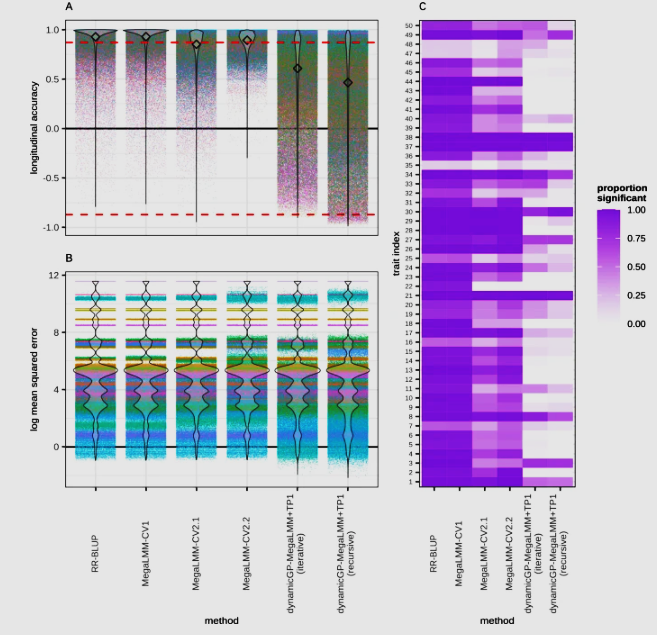
Figure 4: Classical GP models have highest longitudinal accuracy and proportion of significant correlations. A Accuracy of predicted trait dynamics along time series aggregated across all iterations, traits, and genotypes for univariate RR-BLUP models for each trait-time-point pair, MegaLMM-CV1, MegaLMM-CV2.1 and MegaLMM-CV2.2 as well as both iterative and recursive variants of dynamicGP-MegaLMM+TP1. Accuracy was assessed as the Pearson correlation between true and predicted values. All values above the red dashed lined are significant with Bonferroni adjusted p-values 0.05. Diamonds indicate the mean prediction accuracy for each method. B Log transformed mean squared error of predicted trait dynamics along time series aggregated across all iterations, traits, and genotypes for the six methods. Within each method, there are a total of 330,000 tests performed, corresponding to the total number of combinations of 50 traits over 330 genotypes and 20 cross-validation, with each indicated by a point. Colors in A. & B. indicate different traits. C Proportion of significant positive predictive correlations for traits using each of the six methods. For an extended figure containing the corresponding results for the other methods please see Figures S2, S3 and S4. Supplementary Table 1 contains mapping of traits to index.
Views: 119