


Chromosomal variations and evolution in Arachis species revealed by single-copy FISH karyotyping
Guoquan Chen, Qian Wang, Haojie Sun, Liuyang Fu, Xiaobo Wang, Ziqiang Mo, Lijuan Miao, Suoyi Han, Hua Liu, Lina Li, Chenyu Li, Mingbo Zhao, Fanpei Zeng, Yifang Du, Wenzhao Dong, Pei Du & Xinyou Zhang
Theoretical and Applied Genetics; December 21 2025; vol. 139; article 12 (2026)
Abstract
Cultivated peanut (Arachis hypogaea, AABB genome) is an allotetraploid species that likely originated from hybridization between the two wild diploid species A. duranensis (AA) and A. ipaensis (BB). Chromosome identification and genomic evolution studies in Arachis species have encountered significant challenges due to the absence of consensus karyotypes. In this study, we developed the first “barcode” consensus karyotype for peanut using single-copy oligonucleotide probe libraries. This karyotype was applied to identify interspecific hybrids and radiation-induced chromosomal variants, correlate pseudochromosomes with physical chromosomes, and determine chromosomal homoeologous relationships among Arachis species. Analyses of karyotype, chloroplast phylogeny, and similarity heatmaps revealed that A. duranensis and A. ipaensis exhibited the highest similarity to the subgenome of A. hypogaea; certain A-genome species displayed high heterozygosity; and, despite harboring distinct chloroplast genomes, the nuclear genomes of various botanical varieties of peanut were all most similar to A. duranensis accessions from the Rio Seco region in Argentina. Combined with the geographical distribution of A. ipaensis, we propose that outcrossing events may have contributed to the generation of A. duranensis accessions with distinct chloroplasts; subsequently, these accessions likely hybridized with A. ipaensis, leading to the formation of different peanut botanical varieties within an area extending from southern Bolivia to the Rio Seco region. These findings underscore the broad applicability of our new karyotype for distant hybridization, chromosomal identification, and genome evolution research in peanut.
See https://link.springer.com/article/10.1007/s00122-025-05125-1
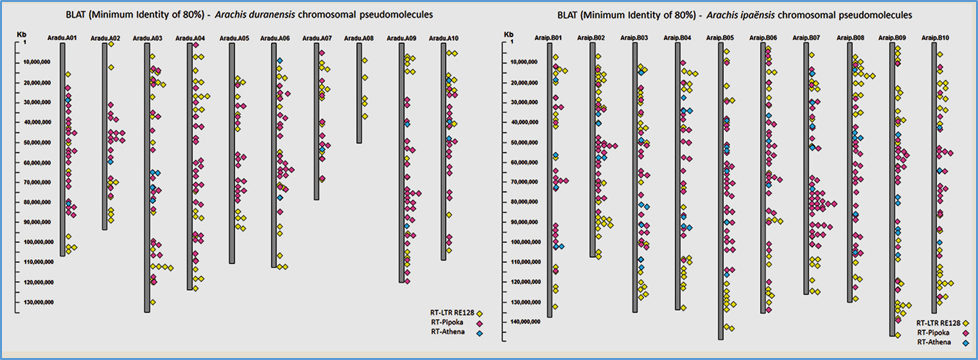
Figure: In silico mapping of the LTR-retrotransposon families, RE128-84, Pipoka and Athena on the chromosomal pseudomolecules of A. duranensis (left) and A. ipaensis (right).
Views: 169