


Blast Resistance Gene Pish Derived Reprogramming of Noncoding RNAs in Rice
Lina Liu, Owais Iqbal, Bingjuan Yang, Yuru Xu, Ping Yu, Md Hasibur Rahaman Hera, Wang Yi, Li Chengyun
Rice (N Y); 2026 Jan 21. doi: 10.1186/s12284-026-00883-y.
Abstract
Rice and Magnaporthe oryzae have co-evolved sophisticated molecular interaction mechanisms. While protein-coding genes (PCGs) involve in the response to M. oryzae have been intensively studied, yet the role of long noncoding RNAs (lncRNAs) remain poorly unclear. In this study, we performed whole transcriptome strand-specific RNA sequencing of rice seedlings from the susceptible recurrent parent cultivar LTH (compatible interaction) and the resistant rice monogenic line IRBLsh-S (incompatible interaction, harboring the resistance gene Pish) following the inoculation with the blast fungus strain Y92-66b. The results revealed that 16.8% of the identified lncRNAs were responsive to blast-infection in the Pish-line at 24-hour post inoculation (hpi). Notably, 45.1% of these blast responsive lncRNAs were novel. Functional analysis indicated that, 49 differentially expressed lncRNAs were co-expressed with genes enriched for the response to oxidative stress and diterpene phytoalexin biosynthetic process (particularly the synthesis of momilactone A). Furthermore, the expression pattern of four lncRNAs correlated with those of genes related to the cell wall macromolecule metabolic process. Here, two lncRNAs (XLOC_046130 and XLOC_040277) were predicted to act as endogenous target mimics (eTMs) for miRNAs and were co-expressed with transcription factors to induce the expression of genes involved in the synthesis of momilactone A. This demonstrates that lncRNAs regulate innate immunity through complex networks involving PCGs, transcription factors, and miRNAs. This study provides new insight into the regulatory mechanisms governed by R genes and highlight the potential role of lncRNAs in breeding and agricultural practices for improved disease management.
See https://pubmed.ncbi.nlm.nih.gov/41563632/
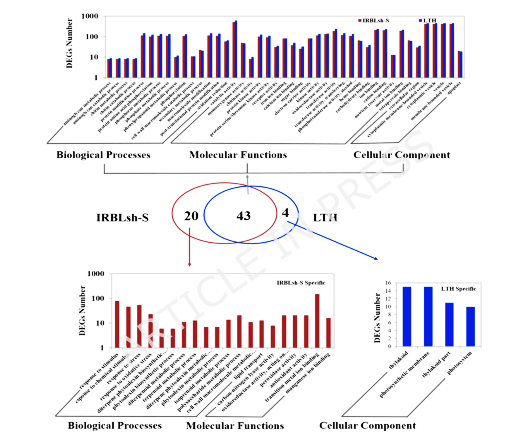
Fig. 3: Enriched GO terms in IRBLsh-S and LTH. The number in the different color circles represents significantly enriched BP and MF pathways in IRBLsh-S and LTH.
Views: 123